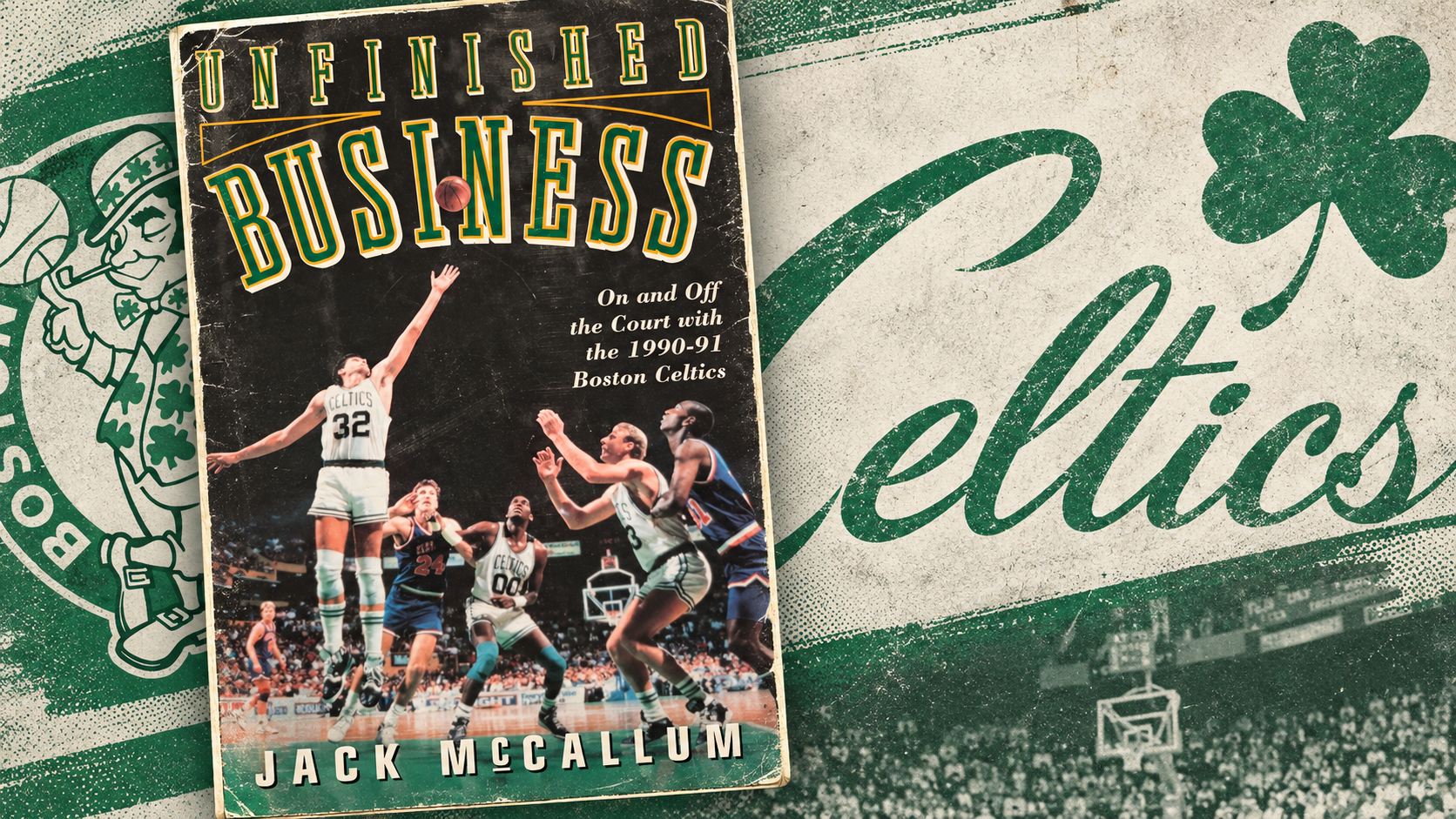
The 1990–91 Boston Celtics, caught between Chris Ford’s attempted revival and the physical decline of Bird, McHale, and Parish
I came to Unfinished Business relatively recently, intrigued by the fact that Bill Simmons had placed it among his personal five favorite basketball books. I already knew what Jack McCallum could do with a team from Seven Seconds or Less and what he could do with a larger piece of basketball history from Dream Team. Even with those expectations, this account of the 1990–91 Celtics struck me as one of the finest basketball books I have read, fully deserving of its place alongside McCallum’s better-known work.
McCallum opens Unfinished Business at the end, outside the visitors’ locker room at the Palace of Auburn Hills on May 17, 1991. Boston has just lost Game 6 of the Eastern Conference semifinals to Detroit in overtime, undone in part by an incorrect offensive goaltending call against Kevin McHale. Robert Parish cannot play because of a sprained ankle. Larry Bird, his back in ruin, slips past the reporters and heads for the bus. McHale has somehow scored 34 points on feet and ankles that require almost constant treatment. Around them, coaches and executives linger without quite knowing what to say.

The scene contains the whole book in miniature. The Celtics are still proud enough to push the defending champions to the final minute, still gifted enough to imagine that another run might be possible, and too physically depleted to complete it. McHale understands the arithmetic of age better than anyone. As he puts it after the loss, “This might be your last chance“.
Published in 1992, Unfinished Business: On and Off the Court with the 1990–91 Boston Celtics belongs to the same tradition as McCallum’s later books Seven Seconds or Less and Dream Team. He is embedded without becoming part of the team, close enough to hear the jokes, arguments, medical evasions, and coaching debates that ordinarily disappear from the public record. The games provide the calendar, but the book lives in hotel lobbies, on buses, inside the decaying Boston Garden, and at Hellenic College, where a franchise built on its past is trying to decide how much of that past can still play.
A Franchise That Refused to Admit It Was Changing
The Celtics arrive at training camp after a humiliating first-round loss to the Knicks in 1990. Jimmy Rodgers has been fired, Dave Gavitt has been hired to modernize the basketball operation, and Chris Ford has become head coach only after Mike Krzyzewski turned down the job. Red Auerbach insists that he remains the final authority, even as contracts, agents, European clubs, and the salary cap have created a basketball world he neither enjoys nor fully understands.

McCallum is excellent on this institutional unease because he never reduces it to a clean struggle between old and new. Auerbach can be territorial, vain, and comically dismissive, yet his presence gives the franchise something no executive can manufacture. He connects Bird’s Celtics to Russell’s, treats every outside challenge as another attack on the family, and still possesses an instinct for people that survives his indifference to modern administration. Gavitt has been hired because Boston needs a different kind of executive, though everyone understands that history still sits in Auerbach’s office, smoking a cigar and handing out Hershey’s Kisses.
The roster is caught in a similar transition. Bird, McHale, and Parish remain the center of everything, but Ford wants Brian Shaw, Reggie Lewis, Dee Brown, and Kevin Gamble to inject pace into an aging team. McHale is asked to return to his old sixth-man role, while Shaw comes back from a season in Italy after a bitter contract dispute. Ford believes running can extend the veterans’ usefulness and prevent the half-court offense from settling into another nightly act of dependence on Bird.

Bird is unconvinced enough for Ford to confront him during camp. The exchange includes Bird’s concise answer, “Fuck you, Doc” yet the value of the scene lies in what follows. Ford does not retreat, Bird stops questioning the offense publicly, and the team begins the season playing at the coach’s preferred speed. McCallum does not inflate the argument into a crisis. On these Celtics, profanity can be a form of negotiation, especially when both men know that Ford’s authority will survive only if he establishes it with the player who matters most.
Boston starts 23–5. The younger players run, the veterans find easier possessions, and McHale rediscovers how naturally he can dominate second units. Bird reaches 20,000 points while passing and rebounding well enough to make the milestone feel almost incidental. Parish, already 37, often looks younger than the players around him. The season begins to resemble a restoration, although McCallum keeps noticing the flaws beneath the record: the difficulty of defending elite athletes, an unsettled fifth starting position, the lack of depth, and a dependence on Bird that no tactical adjustment can remove.
More Than a Season Diary
These were the passages I enjoyed most, because McCallum captures the personalities within the team with an ease that makes proximity feel like observation rather than access for its own sake. Bird and McHale, above all, are brilliant company: competitive, abrasive, endlessly funny, and almost incapable of allowing an ordinary moment to pass without turning it into a joke or a contest. McHale broadcasts his own moves during post-practice games, drifts into discussions about old television shows, and uses humor to keep the misery of his damaged feet at a manageable distance. Parish cultivates silence in public while becoming one of the loudest and funniest players in practice. Bird remembers professional autograph hunters by face, signs Pete Rose’s name when the mood takes him, and turns almost every casual competition into a chance to separate a teammate from twenty dollars.
Bird dominates the franchise without being socially dominant in every room. McHale is more expansive, approachable, and visibly funny, though the humor helps conceal how seriously he works and how much it has cost him to spend his career beside Bird. Parish protects himself through distance, while Reggie Lewis is being prepared to inherit a team whose attention still bends toward the older stars.

The book also keeps wandering beyond basketball, which is one reason it has aged so well. A chapter titled “A Question of Color” moves through Boston’s racial history, the Celtics’ complicated public image, Lewis’s negotiations with the Black agent Jerome Stanley, and the treatment of rookie Dee Brown by police in Wellesley. Brown and his fiancée are stopped while looking for a bank, surrounded at gunpoint, handcuffed, and detained because officers believe he resembles a robbery suspect. McCallum places that episode beside the harassment of Boston Herald reporter Lisa Olson by members of the New England Patriots and the public abuse that follows, examining a city capable of presenting itself as enlightened while fiercely protecting an older social order.
The discussion is not detached from the season. It changes how Brown’s emergence, Lewis’s contract, the city’s response to Stanley, and even the Celtics’ reputation as a white franchise are understood.
There are similar excursions into the commercialization of the NBA, the arrival of European players, the changing relationship between athletes and the press, and the physical decay of Boston Garden. A game against Atlanta is abandoned because condensation forms on the parquet above the ice, prompting jokes about another Auerbach trick while exposing an arena whose romance depended partly on everyone accepting conditions that had become indefensible. McCallum loves the old building without pretending the smell, heat, obstructed seats, and failing infrastructure are charming.
The Body Sets the Limit
The season turns when Bird’s back begins dictating the schedule. Boston goes 7–7 during his first extended absence, and the running game loses more than its best passer. Parish can replace some of the rebounding, McHale can supply scoring, and Lewis can take more shots, but nobody can reproduce Bird’s anticipation or the confidence his presence gives the rest of the team. The Celtics are 46–13 when he plays and 10–12 when he does not, numbers that strip away any remaining illusion about how independent the renovation has made them.
McCallum records the strange theater surrounding the injury as carefully as the injury itself. The club withholds information, reporters chase leaks, Gavitt demands centralized communication, and almost every update manages to produce more uncertainty. Bird dislikes discussing his condition, cannot sit comfortably for long stretches, and sometimes stays home rather than watch from the bench. When he returns, he can still dominate for an evening, including 34 points and 15 rebounds across 52 minutes in a double-overtime victory against Michael Jordan’s Bulls. The performance is thrilling because it offers proof that the old ceiling remains reachable, and unsettling because his body cannot sustain the journey there.
McHale and Parish are deteriorating in quieter ways. McHale’s ankle begins a daily cycle of treatment, pain, competition, and more treatment. His jokes continue, but McCallum recognizes the fatigue underneath them and gives him the book’s richest portrait. McHale has been underrated partly because Bird occupies so much historical space and partly because his own manner disguises the labor behind his footwork. He can sound as if basketball comes easily, then spend an hour after practice refining the movements that make him almost impossible to guard near the basket.
Boston finishes 56–26, a fine record that becomes less convincing with every injury and bad loss. The Celtics survive Indiana in five games after Bird crashes to the floor in Game 5, fractures a cheekbone, and returns in the second half. Against Detroit they produce one last violent swing between possibility and limitation, routing the Pistons in Game 3 before losing control of the series. By the overtime of Game 6, Ford has shortened his team to the few players he still trusts, while Chuck Daly moves specialists in and out according to each possession. Boston’s veterans nearly overcome the difference, which makes the defeat feel honorable without making it misleading.

What McCallum Preserved
The subtitle promises life “on and off the court” and McCallum earns both halves. His basketball writing is specific enough to show why Ford’s ideas worked, why Bird’s absence damaged the defense as well as the offense, and why Detroit’s pick-and-roll became so difficult for an aging frontcourt to contain. He also understands that a season acquires meaning through smaller habits: who arrives last, who lingers after practice, who accepts the teasing, who talks to reporters, and who disappears before the locker-room door opens.

The book occasionally carries more regular-season detail than a modern editor might keep, particularly when the Celtics are moving through the middle of the schedule. I rarely found that density burdensome because McCallum’s subject is time itself. The repeated treatments, flights, shootarounds, minor injuries, tactical adjustments, and jokes show how a promising season is gradually consumed. Nothing collapses at once. The Celtics simply become less capable of recovering from the next demand.
Knowing what followed gives the book another layer that McCallum could not have intended in 1992. Bird played only one more season. Lewis died in 1993. The Garden closed in 1995, and the last links to the 1980s dynasty disappeared one by one. Yet Unfinished Business does not read like an obituary written in advance. For much of the year, the Celtics are lively, funny, innovative, and good enough to make their optimism reasonable. Their 23–5 start is real, the younger backcourt genuinely changes them, and the veterans still possess nights that make the future appear negotiable.
That tension is what places the book beside Seven Seconds or Less and Dream Team among McCallum’s finest work. He understands systems and personalities, but he also knows when to let a room explain itself. After the final defeat, assistant coach Jon Jennings looks back on a season that had revived Boston without returning it to the Finals and says, “It was all unfinished business“. McCallum builds an entire book inside that phrase.
Like any serious work of this kind, it also includes an index, something I consider indispensable, while my 1991 edition features a central section of black-and-white photographs that gives faces to many of the personalities McCallum follows throughout the season.







Leave a Reply