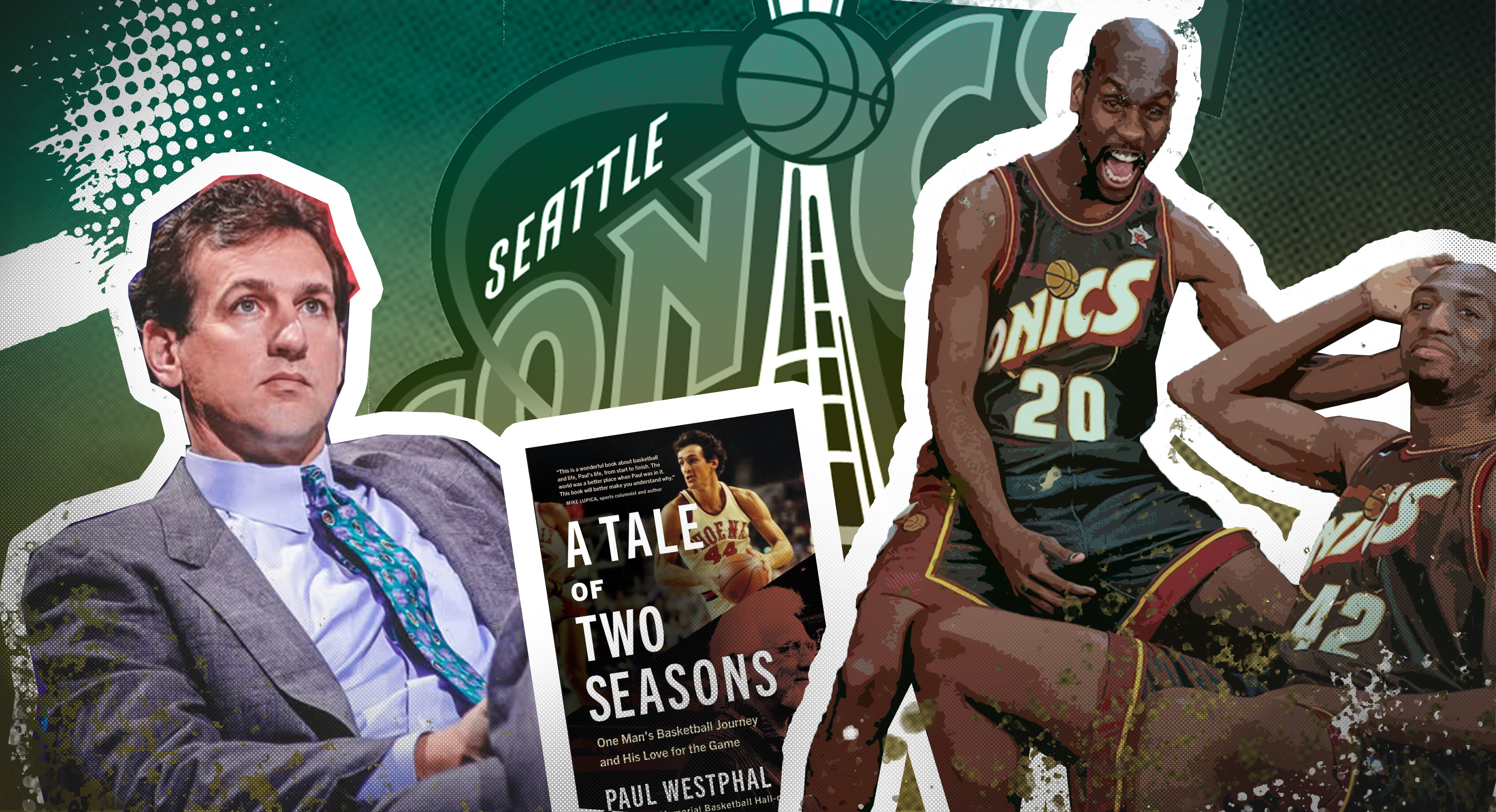
Two vastly different coaching experiences, and a life in basketball told through contrast
The premise of A Tale of Two Seasons is almost disarmingly simple. Two seasons, two jobs, two ends of the same career.
One takes place in the NBA, with Paul Westphal coaching the Seattle SuperSonics at the highest level and for the biggest paycheck of his life. The other unfolds far from the spotlight, at Southwestern College, now Arizona Christian University, where he takes his first steps as a coach without earning a dollar.
And yet, it is that unpaid season he would later call the best year he ever had in basketball.

Published after Westphal’s passing in early 2021, the book uses those two seasons as a framework before moving freely across the rest of his basketball life, from his playing days to his years on the bench.
The manuscript had been sitting on his desk for years, rewritten, reshaped, never quite finished. Westphal completed the final version only a few months before being diagnosed with cancer. After his death, the book was brought to publication by his wife and daughter, Cindy and Higa.
The book is relatively short, just under 200 pages, and not solely about basketball. A devout Christian, Westphal gives a significant place to his faith, as well as to the people around him, friends, colleagues, and the relationships that shaped his life.

Where the book falls short, however, is in how little Westphal revisits his playing career.
At his peak, he was one of the best guards in the league, a true combo guard before the label became commonplace. Between 1976 and 1980, he averaged around 23 points and 6 assists on over 50 percent shooting, earning four All-NBA selections, including three First Team nods, and establishing himself as the engine of the Phoenix Suns.
That stretch remains the core of his legacy, but Westphal barely lingers on it. Those years appear only through brief mentions, light anecdotes, and scattered references to former teammates and peers. Names like Truck Robinson, Pete Maravich, Bill Russell, and Paul Silas make brief appearances, but they are never the focus of the book.
Westphal could have built entire sections around the résumé that led to his Hall of Fame induction in 2019. He simply chose not to.
As is often the case with sports autobiographies, it is the basketball sections that stand out the most, at least for me. The locker room stories, the behind-the-scenes details, the moments where the game reveals itself without filters.
His first experience on the bench at Southwestern College in 1985 (Westphal was 35 at the time, newly retired from his playing career) makes for a genuinely enjoyable read, a young coach discovering the job and embracing every moment of it. Because he was there, that tiny Bible college with almost no national profile suddenly had a reason for a few people in basketball to know it existed. The team won 21 games, but the record is almost beside the point.
He had offered his services for free. Years later, he would describe that season as one of the most enjoyable of his career.
“We had all these 5-foot-10 white guys,” Westphal said, “but they were pretty good.” I won’t go into detail here, as none of the names will resonate with most readers, but Westphal’s memories of learning the job make the section worth reading.

The contrast with Seattle could not be sharper, and having lived through those years, that is what intrigued me the most.
What looks on paper like a solid job quickly turns into something close to unmanageable. Having one or two difficult players was not unusual, Westphal estimated he had as many as six to manage over his two and a half seasons in Seattle, a stint that began in the lockout-shortened 1999 season, following his highly successful run on the Phoenix Suns bench in the early 1990s.
It starts with Gary Payton. Westphal sets up a meeting to connect, talk about the team, lay the groundwork. Payton shows up nearly two hours late. No warning, no apology. Barely engaged once he arrives, refusing to talk basketball and letting his agent carry the conversation. For a franchise player, it sets a tone that is hard to ignore.
Then there is Vin Baker. Once an All-Star, now completely lost in alcoholism. Westphal describes a player missing his first eighteen free throws of the season, drinking vodka at halftime, slipping further out of reach. The organization tries to step in, asking team leaders to stop taking him out at night. The request is ignored, a detail that says plenty about how little concern some of Baker’s teammates seemed to have for the seriousness of his situation.
Westphal also makes clear that he disagreed with the front office’s decision to extend Baker. Given his decline on the floor and the obvious seriousness of his alcoholism, Westphal did not believe a new contract would solve anything. Seattle’s management seemed to think the opposite: that a long-term commitment might give Baker stability, responsibility, and a reason to pull himself back together.
Westphal was right. The extension did not steady Baker. It only deepened the mistake. In August 1999, Seattle signed him to a deal widely reported at seven years and $87 million. Within a year, Baker was making around $9 million, then more than $10 million the following season, while the Sonics were paying for a player no longer close to the All-Star version they thought they had acquired in 1997.
Around them, figures like Olden Polynice and, the following season, Ruben Patterson only add to the instability. At some point, it stops being about basketball. The group becomes impossible to control, resistant to any form of structure.

Westphal also touches on his years with the Phoenix Suns, a far more stable environment, including the trade that brought Charles Barkley to Phoenix in exchange for Jeff Hornacek, Andrew Lang and Tim Perry.
Barkley, in Westphal’s telling, was not the easiest player to coach, but he was far from unmanageable. At times lazy, willing to bend the rules, but fundamentally a good guy.
Westphal occasionally slips into more technical territory:
“Charles was, after Shaquille O’Neal, the worst pick-and-roll defender in the NBA. Maybe ever. One of the biggest factors in our game preparation was to figure out how we could hide Charles’ deficiencies versus the various angles and options we might see from our opponent’s pick-and-roll attack.”
His years in Phoenix, four as an assistant and three and a half as head coach, would likely have deserved more attention, but that was never the book’s intent.
There is also barely a word on his two seasons with the Sacramento Kings, aside from a few brief references to the difficulty of managing DeMarcus Cousins.
A Tale of Two Seasons is a departure from the usual sports autobiography. Westphal makes it clear from the outset that this is not meant to be a conventional life story, but rather a way of looking back on his journey through two coaching experiences that were both emblematic and completely opposed.
Westphal never intended A Tale of Two Seasons to be a conventional autobiography. The two coaching jobs simply give him a way into the rest of his basketball life, from Phoenix and Seattle to the people, relationships and beliefs that shaped him along the way.
The result leaves plenty unexplored, particularly his playing career, but it also gives a clear sense of the coach and person Westphal had become by the time he sat down to write it.












Leave a Reply