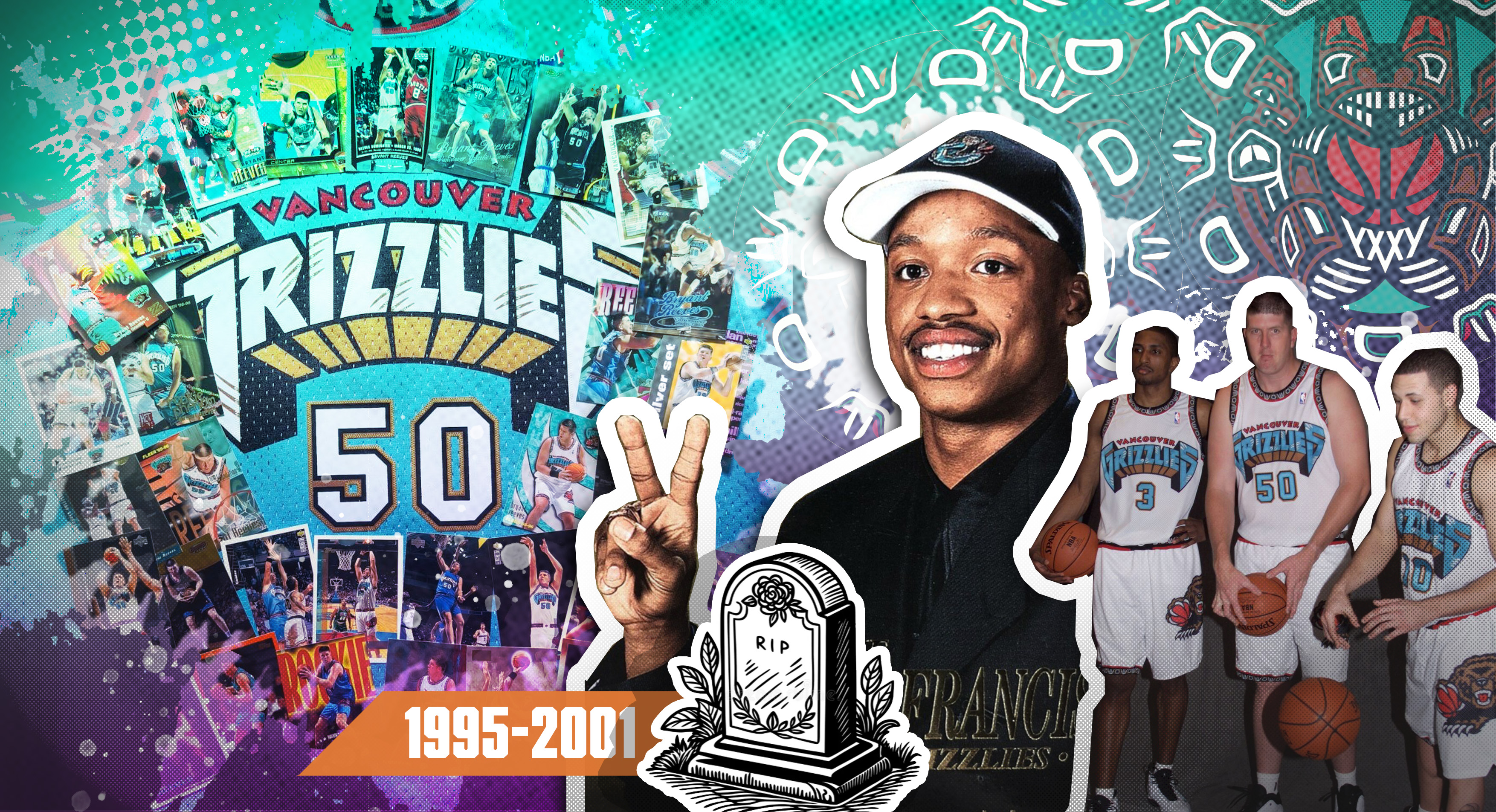
Vancouver made mistakes, but losing an NBA team after six seasons still feels unfair for a franchise that entered the league with restricted tools, brutal timing, and almost no margin for error
During the NBA’s Canadian expansion in 1995, the Raptors had one obvious advantage if you were trying to win over a kid: they had a giant dinosaur on the front of the jersey.
Purple, red, cartoonish, impossible to miss. A few years after Jurassic Park had taken over the world, that was a serious argument. If you were discovering the league through magazines, cards, stickers and jerseys, Toronto should have been the easy choice. Panini’s 1994 album made the announcement feel almost unreal. Two new franchises were coming, and before either one had played a game, their logos already looked like events.
And yet, somehow, I went the other way.

The Vancouver Grizzlies had the jersey that stayed with me. That light turquoise road uniform looked unlike anything else in the NBA. It did not feel like a classic basketball color. It felt new, strange, almost tropical, even though the team played in British Columbia. The logo was busy, the font was aggressive, and the whole thing could have aged badly in about six different directions. Maybe it did. But at the time, it looked like an expansion team should look: different from the rest of the league, a little too bold, not yet disciplined by history.
That is what expansion sold: a new city, a new color, a new logo, a new place on the NBA map.
Six years later, it was gone.
The Grizzlies arrived in 1995 and left for Memphis in 2001. In six seasons, they went 101-359, winning barely 22% of their games. Their best season in Vancouver was 23-59. They never came close to the playoffs or built a lasting identity around Shareef Abdur-Rahim and Mike Bibby. There was no Vancouver version of Vince Carter, and the combination of bad contracts, bad timing, injuries, and economics kept narrowing the road in front of them.
Any honest version of their history has to leave room for the damage they did to themselves.
Still, the speed of the verdict has always bothered me. Six seasons is not much time to build anything in the NBA, especially when the franchise began with fewer tools than expansion teams usually need.
Full Price, Limited Tools
Vancouver and Toronto entered the NBA together, but they did not enter under the same conditions previous expansion teams had received.
The league had learned from Orlando. The Magic arrived in 1989 and, almost immediately, seemed to bend the usual patience required of expansion teams. They won the lottery in 1992 and drafted Shaquille O’Neal. A year later, they won it again, drafted Chris Webber, and turned him into Penny Hardaway and extra draft capital. Within a few seasons, Orlando had gone from expansion curiosity to Finals team. For fans, it was fun. For other owners, it was probably a little too fun.
When the two Canadian franchises arrived, the NBA built in protections against another Orlando jump. Vancouver and Toronto paid major expansion fees, but they began with restricted tools. Their salary cap was limited to two-thirds of the normal cap in year one and remained below the full cap in year two. For their first three years, they also could not receive the No. 1 pick, even if the lottery gave it to them.

That restriction cut into the basic bargain of the NBA draft. Bad teams lose, lose enough, and the top of the draft gives them a way to sell patience as something more than suffering. Expansion teams need that bargain more than anyone, because losing is almost built into their beginning. Vancouver entered the league with part of that mechanism withheld.
The clearest example came in 1998. The Grizzlies won the lottery, but because of the expansion rule, they could not pick first. They selected Mike Bibby second after the Clippers took Michael Olowokandi.
In hindsight, that particular draft did not punish Vancouver the way it could have. Bibby was the better player. The strange part is that even one of the few lucky breaks in Grizzlies history came with a ceiling already placed above it. Vancouver could pay and lose like any other team, without full access to the draft reward that had helped earlier expansion franchises imagine a way out.
The First Face of the Franchise
The 1995 draft gave Vancouver its first face.

Bryant Reeves went sixth. Big Country! Massive frame, soft hands, Oklahoma State hero, easy nickname, easy branding. A new franchise needed someone recognizable, and Reeves gave the Grizzlies that before he gave them anything else. He was a quiet white center from rural Oklahoma whose appeal rested on size and touch in an era that increasingly sold its stars through style and swagger.
It is tempting now to treat the Reeves pick as the first obvious mistake, but that reading is too clean. Vancouver did not pass on Kevin Garnett, Rasheed Wallace, Jerry Stackhouse, Antonio McDyess, or Joe Smith: those five were already gone. The Grizzlies were choosing just outside the strongest layer of the draft, which meant their first major basketball decision already came with a hint of bad timing attached.
Reeves was not a joke. He averaged double figures immediately, and by his second season he was at 16 points and 8 rebounds a night. He was big enough to matter, skilled enough to justify patience, and young enough for the franchise to imagine that the next step was still coming. When Vancouver extended him in 1997, the move was framed as proof that the Grizzlies could keep their own cornerstone.

That contract is one of the more revealing moments in the franchise’s short life. Reeves was 24 years old, productive, homegrown, and willing to stay. At the time, his extension was described as one of the richest deals for an athlete on a Canadian sports team, and Reeves himself said it sent a message that Vancouver was a good place to play and that the team was headed in the right direction.
The direction changed quickly. Reeves’s back problems and conditioning issues turned a statement of stability into a burden, and the contract became heavier as the team around him failed to grow. The original logic was hardly ridiculous. Vancouver simply had almost no room for it to age badly. A more established franchise can survive a young big man leveling off or breaking down. The Grizzlies needed their first cornerstone to become something close to the best possible version of himself.
Instead, Reeves became a symbol of how quickly an expansion plan can harden into regret.

A Foundation, At Least on Paper
After two seasons, the Grizzlies were terrible, but they were not always written about as hopeless. They had won only 29 games, their offense was ugly, and their defense gave back too much of whatever progress the roster seemed to make. Still, contemporary previews found traces of a possible foundation. The tone around the 1997-98 team was not triumph or burial so much as strained patience.
The 1998 Complete Handbook of Pro Basketball caught Vancouver at that in-between stage. Its scouting report preached patience, then pointed to modest signs of improvement: better shooting, a young frontcourt, Shareef Abdur-Rahim already looking like the franchise’s best player, and Reeves beginning to look like a real NBA center. Roy Rogers added size and youth, at least in theory, but the Alabama big man quickly became another reminder of how fragile that imagined foundation really was. He showed flashes as a rookie shot-blocker, then faded fast, leaving Vancouver before the new season and the NBA not long after.
The warnings were easy to find. A team with that much frontcourt size still rebounded poorly, and the interior defense was soft. Opponents shot too well, while the offense had too few creators. Antonio Daniels was a rookie being asked to organize a franchise that had never really known organization.

The third season did not turn those warnings into progress. Vancouver won only 19 games in 1997-98, and behind the Abdur-Rahim/Reeves duo, which did about as much as it could, the roster remained thin. George Lynch, brought in after his Lakers years, gave the team some real NBA edge and usefulness on the wing. Tony Massenburg and Blue Edwards helped in smaller ways. After that, there was not much separation, and not much to suggest that the foundation on paper was becoming a foundation on the floor.
There was still a version of the Grizzlies that could be imagined as a slow build, especially if Abdur-Rahim and Reeves grew together and the franchise found the right guard to pull the roster into shape. It was thin, but it existed.
Most of that hope ran through Shareef.
Abdur-Rahim was the best player Vancouver ever had. He was productive almost immediately, smoother and more advanced than the roster around him, and consistent in a way the franchise badly needed. He could score, rebound, handle enough, and give the Grizzlies a serious young player to build around. For several seasons, he looked like proof that Vancouver had at least found one real NBA cornerstone.
But his career also ran into a familiar ceiling. On bad teams, steady production can start to look suspicious: Abdur-Rahim was talented, reliable, and often left carrying more offense than the roster around him could support, yet the losing gradually pushed him toward the old empty stats label.

He was not Vince Carter, and that distinction became one of the cruel dividing lines between the two Canadian teams. V.C. arrived in Toronto with flight, violence, charisma and highlights that moved faster than standings. He gave the Raptors an image before they had a long history, he made people outside Toronto care and made a young franchise feel visible.
Abdur-Rahim was excellent but Vinsanity was an event. Vancouver never found that kind of player.
Toronto Was Not Vancouver With Better Luck
Toronto is the obvious counterargument, since the Raptors entered under the same Canadian expansion rules and faced the same basic problem of establishing a Canadian franchise in an American league.
The differences between the two cities mattered. Toronto had the same restrictions as Vancouver, but its margin for error was larger. Its market was nearly twice as big, with a deeper corporate base, more media weight, and a larger local audience before Vince Carter ever arrived. Long before the Raptors found their spectacular dunker, they had structural advantages that made the early ugliness of expansion easier to absorb.
V.C. accelerated the project after arriving in a market already equipped to turn a star into momentum.
The Star Who Never Arrived
The Steve Francis episode still feels like the symbolic end of Vancouver’s NBA innocence.
The Grizzlies finally had access to the kind of player expansion teams dream about. Francis was explosive, fast, marketable, and young, a guard who could have turned a bad team into a nightly event. After the Reeves gamble had begun to sour, and after the franchise had missed the cultural lift that Carter gave Toronto, Francis looked like the first Grizzly who might sell a future before the future actually existed.
Vancouver took him second in 1999, and almost immediately the story became something else.
Vancouver was not where he wanted to begin his career. He spoke about the distance from home, being far from the grandmother who had helped raise him after his mother’s death, and the unease of beginning his NBA life in a distant market with a struggling expansion team. The taxes and market size entered the conversation too, along with the city’s geography and the roster’s bleak prospects. Whatever weight each factor carried, Francis didn’t want anything to do with Vancouver.

Stu Jackson tried to manage the situation publicly, but the whole episode made Vancouver look smaller. The Grizzlies had his rights, could offer rookie-scale money, and could give him a chance to become the face of a franchise. Yet even that sales pitch carried a kind of humiliation.
The trade that followed only deepened the damage. Francis was eventually sent to Houston before playing a single game for the Grizzlies, with Tony Massenburg also leaving in the deal. Vancouver got useful players back, especially Michael Dickerson and Othella Harrington, but the return felt more like damage control than franchise repair. Antoine Carr and Brent Price were veterans, the picks were future assets, and none of it came close to replacing what Francis was supposed to be: the young, explosive, marketable guard who could have changed how the franchise felt.
The Mistakes Were Real
None of this clears Vancouver’s basketball operation.

The Grizzlies drafted unevenly, built awkward rosters, cycled through roles, and never created a stable basketball language. Some of their decisions were understandable in the moment, but too many of them left the franchise stuck between a future it wanted to sell and a roster that could not support it. Reeves became expensive and fragile, Daniels never developed into the point guard they needed, and the Francis pick ended in public rejection, leaving even the better pieces, especially Abdur-Rahim and Bibby, trapped in a franchise that could not build around them quickly enough.
The franchise’s failures went well beyond its circumstances, which places Stu Jackson near the center of this part of the story. He operated in a difficult setup and was also the person most closely tied to the basketball choices that defined the Vancouver years. The Grizzlies needed drafts that would accelerate them, contracts that would age well, and a roster plan that gave fans visible progress. They got pieces of that, never enough of it at once.
Bad teams make mistakes all the time. Most of them are allowed to keep making them long enough for the story to become something else. The Grizzlies made theirs on harder ground, with no established fan base to cushion them, no superstar to distract from them, no full early access to the draft’s highest reward, and no friendly exchange rate softening the financial damage.
Vancouver did not have to be perfect to deserve more time, yet its early mistakes became evidence in a trial that seemed to end almost as soon as it began.
The Canadian Problem Was Real, Even When It Became a Cliché
The Canadian dollar can sound like an excuse because it has so often been used as one. In Vancouver’s case, it was part of the actual machinery of the collapse.
NBA salaries were paid in U.S. dollars, while much of the Grizzlies’ revenue came in Canadian dollars. That mattered more as the decade went on. In 1995, one Canadian dollar was worth about 73 U.S. cents. By 2001, it was closer to 65 cents. Put the other way, every US$10 million in salary cost about C$13.7 million in 1995 and about C$15.5 million by 2001.
The gap still exists today. In August 2026, one U.S. dollar was worth about C$1.39, meaning US$10 million in salary would cost roughly C$13.9 million. Around the time Vancouver lost the team, the exchange rate was even harsher, and the franchise had almost none of the cushions that might have made it survivable.
What might have remained manageable for a healthy franchise became a trap for a losing expansion team with falling attendance, as guaranteed contracts grew heavier in local terms and each empty seat deepened the financial cost of another bad season.
Taxes added another layer. The story was more complicated than players simply refusing to pay Canadian taxes; contract structure, residency, and trade status all mattered. The basketball world rarely processes those details patiently, however, and Vancouver acquired a reputation as an inconvenient, expensive, or simply undesirable destination.
The Crowd Was There Until Losing Ate It
Vancouver did not reject the NBA from the beginning.
That part of the story gets lost when the franchise is reduced to empty seats and relocation. In their first season, while going 15-67, the Grizzlies drew more than 17,000 fans per game at home, almost exactly in line with the league average and good enough to place them around the middle of the NBA attendance table. For a team losing almost every night, that was not indifference. That was a market giving the new thing a real chance.
The erosion came later, after the novelty wore off and the losing never did. There is a difference between asking fans to support a young team and asking them to keep investing in a future that becomes less believable every year. Vancouver gave them 15 wins, then 14, then 19, then eight in a lockout-shortened season. The front office sold Reeves as a cornerstone, then watched his body fail him. It drafted Francis, then watched him refuse the premise of the franchise. Ownership uncertainty and relocation noise made it even harder for fans to believe that patience would be rewarded.
By 2001, attendance had fallen toward the bottom of the league as the team continued to lose heavily. The franchise no longer felt new, yet it had not existed long enough to become rooted, and without a convincing reason to keep waiting, the history behind the logo remained too thin to hold the place together.
By 2001, the Exit Was No Longer Hidden
Michael Heisley inherited the Vancouver crisis and became the owner who brought it to its conclusion.
He bought into a damaged situation: the Grizzlies were bad, attendance had fallen, losses were mounting, the Canadian dollar was working against them, and the earlier Bill Laurie attempt to buy the franchise and move it to St. Louis had already made the future feel unstable. The team had barely existed, and the possibility of leaving was already part of the air around it.
By February 2001, relocation was no longer just background noise. David Stern gave Heisley permission to explore moving the team for the following season, with St. Louis, New Orleans, Memphis, Las Vegas, and Nashville mentioned as possible destinations. The timeline was brutal: if Heisley wanted to move by the next season, he needed to apply by March 1.

On March 26, after the original deadline had been extended, Heisley selected Memphis and formally applied to relocate the franchise there. The NBA’s Board of Governors unanimously approved the move on July 3, bringing the Vancouver Grizzlies to an end after only six seasons.
The reported losses were enormous, around $40 million for the year. Heisley’s desire to find an exit made business sense; owners do not usually absorb that kind of damage out of historical generosity. The franchise was plainly unhealthy.
The business case did not make the verdict fair. Vancouver never got to move from expansion failure into ordinary franchise failure, the kind that can be repaired with a better draft, a better coach, a better owner, or simply more time. The team went from new to troubled to movable before a generation of fans could grow with it.
Minnesota Got Time
Minnesota is the comparison that stays with me.
The Timberwolves entered the NBA in 1989, and their first years were miserable. They won 22 games, then 29, then 15, then 19, then 20, then 21. Six straight seasons under 30 wins, with no playoff appearance, no real identity, and very little evidence that the franchise was close to becoming something else.

Then they got time for the bad years to produce Kevin Garnett.
Minnesota’s sixth bad season led into the 1995 draft, where the Wolves took Garnett fifth and finally found the player who could turn an expansion mess into a franchise story. Vancouver’s sixth bad season also led into a draft that produced a future Rookie of the Year big man. By then, the team was no longer really Vancouver’s to keep. Pau Gasol was selected third by Atlanta in 2001 and sent to the Grizzlies in the Shareef Abdur-Rahim trade, just as the franchise was leaving Canada for Memphis.
Minnesota’s six losing seasons eventually produced a beginning with Garnett; by the time Vancouver reached the same point in its history, the future represented by Gasol already belonged to Memphis.
The Team That Never Got to Breathe
Vancouver made enough mistakes that the failure cannot be blamed only on the league, the market, or the exchange rate. The record is too bad, and the basketball decisions too uneven, for any other reading. But the punishment still feels too harsh.
A city should not have to be perfect immediately to deserve an NBA team, nor should an expansion franchise be expected to survive six years of losing under restricted rules, bad economics, market skepticism, and relocation noise, only to be treated as if the verdict had been obvious from the start.

Maybe Vancouver would never have worked and maybe the market needed a more international league, a more digital media world, and a basketball culture less dependent on the old American map.
Toronto had the dinosaur at the start, then Vince Carter at the perfect time, and a market large enough to survive the ugly years. Vancouver had the turquoise jersey that caught my eye as a kid, a few good young players, too many losses too quickly, and only six seasons to make all of it mean something.
That still does not feel like enough.










Leave a Reply