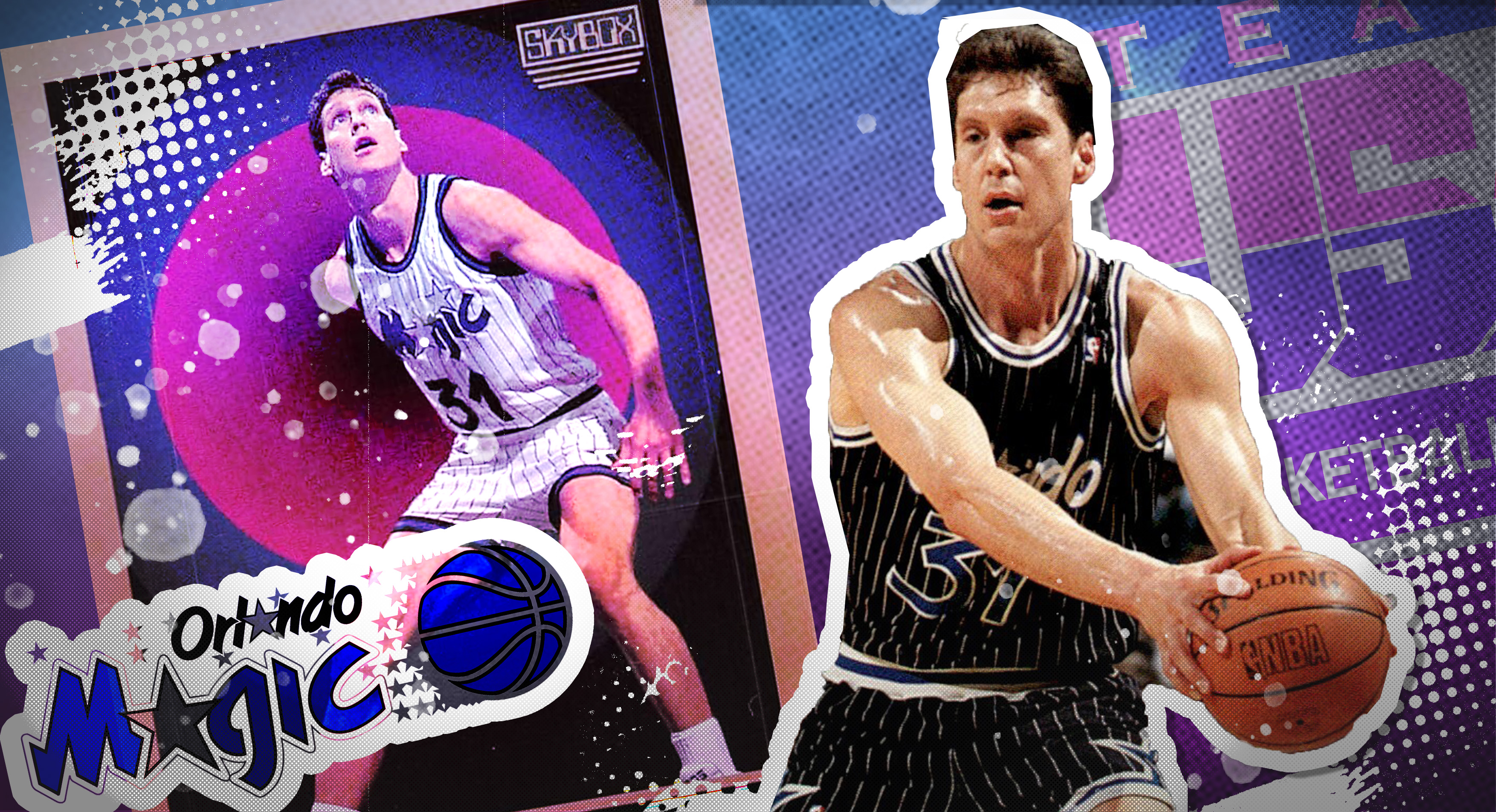
From Olympic gold with Team USA to a steady role in Orlando’s rise, the career of a quiet utility forward
Born in 1962 in the state of Maine, Jeff Turner was not particularly drawn to basketball. As a kid, his true passion was baseball. He only started playing hoops at thirteen, casually and without much conviction.
What followed was the familiar story of a teenager who, growing inch by inch, naturally drifted toward a sport better suited to his body. After moving to Florida and beginning his freshman year at Brandon High School, Jeff initially planned to join the baseball team at sixteen. But at 6-foot-5, he now stood out. That sudden growth became a liability for baseball and an asset for basketball. He made the team and thrived. Brandon became one of the strongest high-school programs in its area, and he earned All-West Conference First Team honors as a senior.

In 1980, at eighteen and now fully grown to 6-foot-9, Jeff enrolled at the prestigious Vanderbilt University in Nashville, where the star player was Charles Davis (future NBA reserve forward for the Bullets, Bucks, and Bulls through the 1980s). Turner completed a solid four-year college career while keeping his primary focus on his law studies. As a freshman, he was selected to the North Florida AAU All-Star Team, commonly known as “Team Florida,” and even played an exhibition game against the Great Britain Olympic team in 1980.
His senior season with the Commodores, 17 points and 7 rebounds on 53% shooting and 84% from the line, secured his place in the greatest draft class in history, the legendary 1984 crop: Jordan, Barkley, Olajuwon, Stockton, Alvin Robertson, Otis Thorpe, Kevin Willis, all future All-Stars at minimum, many Hall of Famers.
Jeff Turner was selected in the first round, 17th overall by the New Jersey Nets. We will return to that shortly.
Before he ever turned pro, however, Jeff Turner took remarkable detours with Team USA, becoming one of the most internationally experienced young American players of his generation.

1982-1984 Olympic gold with Team USA
Preparing for the Los Angeles Olympics, the United States intended to reclaim gold four years after boycotting Moscow. Bobby Knight, the legendary Indiana Hoosiers coach from 1971 to 2000, served as commander in chief, assisted by C. M. Newton, Turner’s coach at Vanderbilt. Jeff Turner was part of the campaign from the earliest training tours.
He had already been on the U.S. team two years earlier, winning silver at the 1982 World Championship in Colombia, losing the final by one point to the Soviet Union led by an unstoppable Anatoli Myshkin. The team was led by Marquette point guard Doc Rivers, tournament MVP.
Not yet twenty, Turner already possessed more international experience than the vast majority of American players. He had represented Team USA multiple times in Europe, Japan, and Taiwan in exhibition tours, facing young Arvydas Sabonis, Fernando Martín, and Dražen Petrović as well as established stars like Delibašić, Dalipagić, Kicanović, Epi, Tkachenko, and Rolando Frazer. An unthinkable trajectory for someone not yet a professional, who only months earlier had expected to finish law school and become an attorney.
Selection for the home Olympics was brutal. Roughly one hundred players attended the Bloomington camp at Indiana University. The pool was cut to forty, training three times daily. Then thirty. Finally twelve players plus two alternates.
On the final roster, composed exclusively of college players as was standard then, Turner joined the frontcourt rotation alongside Sam Perkins, Wayman Tisdale, Jon Koncak, Patrick Ewing, and Joe Kleine, who like Turner had also played in 1982. The backcourt featured Michael Jordan, Chris Mullin, Vern Fleming, Alvin Robertson, Leon Wood, and nineteen-year-old Steve Alford.
The run was flawless. No losses across exhibitions and Olympic play, averaging 95 points scored and 63 allowed, and an Olympic gold medal.
The 1984 team would be the last U.S. Olympic gold medalist composed entirely of college players.

Individually, Turner played about ten minutes per game but appeared in all eight Olympic games on a roster led by Jordan, Mullin, Ewing, and Alford. He did not get a direct rematch with the USSR, which boycotted Los Angeles.
1984–1987 Draft, Big Macs, and uneven beginnings in New Jersey
Like several of his Olympic teammates, Jeff Turner was not present at Madison Square Garden for the 1984 draft. Team USA was still in training at Bloomington. His newly hired agent was confident. The Celtics at 23 or the Lakers at 24, he believed, would select Turner late in the first round. Lakers executive Jerry West had been the only general manager to contact Turner directly.
The stress built. Turner later told Australian podcaster Adam Ryan:
“We were in a TV studio in Bloomington. Michael Jordan walked out first. Then Sam Perkins, Robertson, Leon Wood. Vern Fleming and I were sitting there, and I’m thinking, “Oh my God, Jordan, Perkins, all these guys are going to the van and I might not get picked. I might go second round.” The 17th pick comes and it’s the New Jersey Nets. Vern, who’s from New York, tells me I really don’t want to go to the Nets. When they announced my name, the Madison Square Garden crowd booed. They had no idea who “Jeff Turner from Vanderbilt” was. I’ll never forget Vern looking at me and saying, “I’m sorry.” Vern went 18th to Indiana. We walked out together.“
Six members of that Olympic team were drafted in the first round. No ceremony, no suits. The coaching staff took everyone to McDonald’s to celebrate, then it was back to the gym.
Instead of the modern draft spectacle, complete with tailored suits and ego theater, it was saturated fat and Big Macs.

Turner entered a respectable Nets team and immediately became the primary backup to All-Star Buck Williams at power forward. The 1984–85 season was mixed. New Jersey scraped into the playoffs at 42 wins and was swept 3-0 by Detroit. Turner played 72 games, starting 36 due to injuries. Solid beginnings and significant minutes for a rookie. The problem was positional misuse.
He was thrown into the mix early, which cut both ways. Built as a power forward, with some spot minutes at center, he ended up on the wing out of necessity when Albert King and Mike O’Koren got hurt. Suddenly, he was checking the league’s toughest covers: Bird, Wilkins, Bernard King, Worthy, Dr. J.
But the next two seasons, 1985–86 and 1986–87, now under Dave Wohl, were bleak for New Jersey: 39-43 and another first-round sweep, then 24-58 and no playoffs. Turner played 129 games across those seasons, starting 23, but showed little progression. After three full years, new GM Harry Weltman declined to retain him. The Nets would sink further before glimpsing hope in the early 1990s with the short-lived Dražen Petrović–Derrick Coleman–Kenny Anderson trio.
1987–1989 Cantù, the Italian interlude
He and his wife, who had played at Vanderbilt, had just settled into a small house in Nashville. After three NBA seasons, he was already bracing for the end. Then came a call from Warren LeGarie, not his agent but well connected internationally, with an opportunity in Italy. The trip was on him. The team was legit, even if it was based in one of the league’s quieter cities.
That team was Vismara Cantù, a Lombardy town where Jeff Turner would thrive for two seasons. Today the club sits in Italy’s second division, but at the time it was a major force domestically and in Europe: Italian champion in 1981, EuroLeague winner in 1982 and 1983, plus three Korać Cups in the 1970s. Turner quickly became one of the team’s leaders alongside Antonello Riva and Dan Gay, finishing third in the league in his first season, 1987–88.
The following year Cantù reached the Korać Cup final, losing on aggregate to Partizan Belgrade led by Vlade Divac and Aleksandar Đorđević. In the previous round they had eliminated Split, featuring young Toni Kukoč and Dino Rađa.

1988 Jeff Turner with Vismara Cantù, where he became one of Europe’s top interior players. Credit: Vismara Cantù Archivio fotografico famiglia Allievi
That season Turner was considered one of the top interior players in European basketball. Another American, center Kent Benson (#10 in the photo), joined Cantù after a twelve-year NBA career, mostly with Detroit.
1989–1996 Orlando utility man, from expansion to the Finals
Summer 1989. Jeff Turner, now 27, returned to the United States. A free agent, he signed with the expansion Orlando Magic, preparing for its inaugural NBA season, becoming the first free agent in franchise history.
His Nets stint had left him unsatisfied, and he saw Orlando as a chance to extend his NBA career. Florida also meant home. His entire family lived in the Orlando area. After an initial camp with the other 1989 expansion team, Minnesota, Turner immediately joined Orlando’s camp, staying at his mother’s house just miles away. The contract followed quickly.
Make no mistake. The Magic years were not exactly bliss. Expansion franchises struggle. Reaching 30 wins is hard: rosters are patchwork, success depends on draft luck. There was no home team waiting for him in Central Florida. Like a lot of kids, he adopted his favorites, Julius Erving’s Sixers, the Knicks with Earl Monroe, Willis Reed, and Walt Frazier, but it never felt local.
The closest thing came from other sports, Atlanta in baseball, the Miami Dolphins in football. That is why he assumed Orlando would struggle to draw a crowd. Instead, the city showed up right away, even as the losses piled up to 64.

1989, the very first official photo / Orlando Magic
From that modest start, Orlando accelerated quickly and fared far better than fellow expansion peers Miami, Minnesota, and Charlotte. Thirty wins arrived in year two, followed by a deliberate tank season. A .500 record came in year four, playoffs in year five, and an NBA Finals appearance in year six.
Drafting Nick Anderson, Dennis Scott, Shaquille O’Neal, and Penny Hardaway made all the difference. Four hits in five years (the lone miss being Brian Williams, later Bison Dele) formed 80 percent of the 1995 Finals starting lineup.

Within that rising contender, first coached by Matt Guokas then Brian Hill, Jeff Turner carved out a role immediately and never lost it: a power forward able to provide about twenty solid minutes and three fouls, rotating with Terry Catledge, Tom Tolbert, Larry Krystkowiak, and eventually Horace Grant, the All-Star and unquestioned starter after his 1994 arrival. Before Grant, Turner started 171 of 349 Orlando games.
He carved out his place as a role player, the kind teams rely on but rarely spotlight. In today’s game, he would have fit the stretch four mold, a big who could step out and space the floor. He understood that early and built around it, taking care of his body, figuring out how to last. Opportunities came when injuries hit, and more often than not he ended seasons as a starter. The arrival of Horace Grant reset everything, though, pushing him back into a supporting role with fewer minutes. By then, he had added another layer, turning himself into a legitimate threat from three.
Indeed, in 1994–95 Turner attempted 1.5 threes per game in just twelve minutes at 36 percent. A tiny volume by modern standards but significant for the era, especially for a 6-9 interior player.

In February 1996, at 32, he was traded to Vancouver for Kenny Gattison in what became a phantom deal. Turner never played for the Grizzlies, and Gattison, sidelined by a back injury, never appeared for Orlando and soon retired. The explanation was simple. With Shaquille O’Neal approaching free agency, Orlando needed salary flexibility. New GM John Gabriel executed one of the early cap-driven trades. A purely financial exchange of two players no longer able to play.
Turner, largely healthy throughout his career, was now limited by his left knee. Two surgeries in four months changed nothing. The meniscus was gone. His career ended after 636 NBA games plus two full Italian seasons.
Newly retired, he immediately became Magic radio color commentator for several years alongside David Steele, then coached high school basketball at Orlando Lake Highland Preparatory School for eight seasons. For nearly a decade now he has served as television analyst for the Magic, again with Steele, calling Orlando games on NBA League Pass.








Leave a Reply