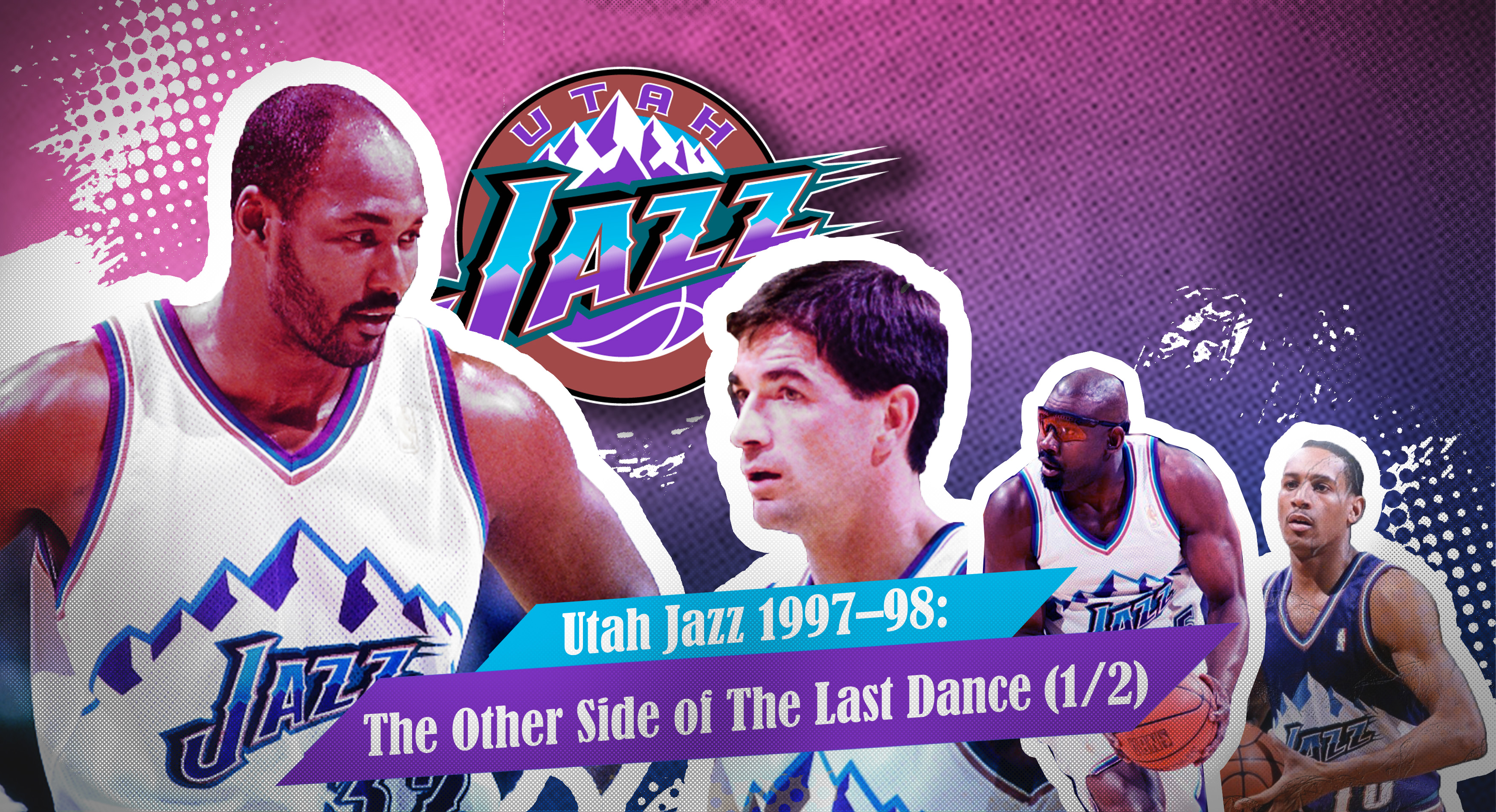
A remarkable season on the court, far more complicated behind the scenes. The Jazz’s final run against Michael Jordan’s Bulls
June 13, 1997. Chicago wins the fifth NBA title in franchise history, defeating the Utah Jazz 4–2 in the Finals. One year and one day later, the same matchup would once again end with the Bulls on top.
From the winners’ side, the story has been told countless times. The Last Dance played a major role in turning Michael Jordan and his teammates’ run into modern basketball mythology.
Far less attention has been paid to the Jazz, who delivered another remarkable season, 62 wins and a playoff run that included a sweep of the Lakers in the Western Conference Finals. On paper, Utah’s 1997–98 campaign was nearly flawless.
Behind the scenes, however, things were far from simple.
That is what this long-form piece sets out to explore, the hidden story behind a season that looked exemplary on the court but was far more turbulent behind the scenes.
The Summer After the 1997 Finals: Free Agency and Extra Weight
The first issue of the summer is free agency. Six players are involved. Owner Larry Miller, GM Scott Layden, and team president Frank Layden, still the real power behind the franchise as the 1990s wind down, have decisions to make and contracts to sort out.
After reaching their first NBA Finals, the message inside the organization is clear: no rebuilding as long as John Stockton, Karl Malone, and Jeff Hornacek are still performing at a high level. The front office believes the championship window will not stay open for more than two seasons. So that summer, they spend. Six players hit free agency. Five are brought back.
Bryon Russell signs a five-year, $20 million deal, a major payday for the forward drafted by Utah in 1993. Hornacek, who will turn 35 before the end of the season, signs on for two more years before retirement. Young reserves Howard Eisley and Shandon Anderson each receive two-year contracts, while Antoine Carr returns for one more season.
The only player not retained is Stephen Howard. His roster spot goes to 22-year-old rookie Jacque Vaughn, a point guard out of Kansas who completed a full four-year college career and is already sporting a shaved head.
In total, more than $70 million is committed to stabilizing the roster. It is the most the Jazz have ever spent.
But that wave of spending quickly creates tension inside the locker room. The Greg Ostertag situation becomes the focal point. The center has the option to sign an extension before the season or wait until the following summer to test the market. His strong 1997 playoff run reassures the front office, and Larry Miller, who ultimately controls the purse strings, fears that if Ostertag improves again, he could command a massive deal similar to the one Bryant Reeves had just signed in Vancouver, more than $60 million over six years.
Ostertag’s agent, Jeff Austin, proposes a compromise: a contract slightly below market value, a gesture meant to show loyalty to the Jazz. Miller accepts immediately:
Six years, $39 million.
A massive payday for a player known for his inconsistency and a reputation for being notoriously lazy.
Karl Malone is furious. He had advised Miller not to offer Ostertag a long-term deal, convinced the center would be more motivated playing for a new contract. The same logic, in his mind, applied to Bryon Russell. When Malone learns the numbers, he is livid, especially since, despite his MVP-level status, he remains one of the lowest-paid superstars in the league, $5.1 million, only the 35th-highest salary in the NBA.
Malone takes it as a personal insult.
While Malone spends a brutally disciplined summer at his Arkansas ranch, waking up at 6 a.m., StairMaster workouts, track sprints, and daily weight training, Ostertag arrives at training camp looking like he spent the summer working in a McDonald’s kitchen rather than in the weight room.
Nine kilos overweight. Body fat completely out of control.
Malone is boiling:
A damn shame. It’s literally a damn shame that we were so close to winning and guys didn’t take their off-season serious enough about getting in shape. That is a disgrace as a professional athlete. It’s a disgrace that Coach Sloan will have to say something, or he’ll have to run some of us because other guys have been fat-asses all summer. Those same people like to talk about how good they are, so I’m pissed off right now.
He does not name names, but everyone understands: Greg Ostertag and Antoine Carr are the targets.
Carr, also out of shape, violates the weight and conditioning clauses in his contract. Worse, he injures his hamstring as soon as training camp begins.
The atmosphere grows even more tense when Larry Miller decides to move training camp to Boise, Idaho, nearly 300 miles from Salt Lake City, to promote his car dealerships. A businessman’s idea the veterans hate. It disrupts their routine and forces them into mandatory autograph sessions. John Stockton and Karl Malone openly complain. The mood inside the team keeps tightening.
And when Miller publicly praises Ostertag and Russell as the future of the franchise, that is the final straw. Malone goes straight at Tag:
You want to be the man? Be the man now. Step up. Maybe then I can play four or five more years.
The tone is set. The Jazz enter the 1997–98 season on edge. The roster looks stable on paper, but inside the locker room, it is a different story. Some players had clearly taken the summer more seriously than others.

Shandon Anderson. Like his older brother Willie Anderson, a Spurs guard from 1988 to 1995, Shandon was seen as a promising player who ultimately did not quite live up to expectations, relative to their very different paths. Willie had been a top-10 pick and averaged nearly 19 points, 5 rebounds, and 5 assists as a rookie, while Shandon entered the league as a late second-round flier with a far more limited offensive game.
In 1997, he is just a rookie, but he quickly establishes himself as the Jazz’s sixth man. His minutes steadily increase throughout the playoff run, eventually reaching nearly 21 per game against the Bulls in the Finals. An unlikely rise for the lowest-paid player on the roster.
What is often forgotten is that he missed Games 3 and 4 to attend the funeral of his father, who had died of throat cancer, in the middle of the NBA Finals.
His new contract extension and Coach Sloan’s full confidence offered him some comfort as he prepared to enter his sophomore season.
The Day John Stockton Finally Missed a Game
A small earthquake hits Salt Lake City before the start of the 1997–98 season: Stockton is going to miss a game. In fact, several.
At 35, he undergoes surgery for the first time, on his left knee. Until then, he had missed just four games in thirteen seasons: two because of a sprained ankle, and two during the 1988–89 season due to a viral infection.
An extraordinary level of durability, reflected in his third-place ranking on the NBA’s all-time consecutive games list with 609.
Even more remarkable given that Stockton was known for never missing a practice, a weight room session, or even a simple pickup game.
The start of the season will clearly be without him.
At point guard, it falls to 24-year-old Howard Eisley to run the offense, with rookie Jacque Vaughn serving as his backup.

Howard Eisley had only just shed the journeyman label that summer. Early in his career in 1994, he had been cut by both Minnesota and San Antonio. Undersized, around 175 pounds at 6-foot-2, he had to take a detour through the CBA, the predecessor to today’s G League, to revive his career after struggling to stick in the NBA.
But the previous season, his first full one in the league, he had found his role: John Stockton’s primary backup. The minutes were limited, about 13 per game, but he appeared in all 82 games. After a steady playoff run, shooting 50 percent from the field and going 27-for-28 from the free throw line, Eisley had earned Jerry Sloan’s trust to handle things behind the Jazz legend.
Backing up Stockton is no small task. But Eisley seems to have what his predecessors lacked: some were not good enough, like Jim Les and Delaney Rudd, some unreliable, like Eric Murdock, some already declining, like Jay Humphries, and some simply forgettable, like John Crotty.
During the offseason, Eisley even turned down an offer from the Clippers, who were willing to give him a starting job and a better contract. But after experiencing the NBA Finals, he had no interest in leaving the only team that had truly given him a chance.
Naturally quiet and reserved, he is now asked to step into the spotlight for two months in place of the man Jack Ramsay once called the best half-court passer the game had ever seen.
With John Stockton sidelined, the start of the season proves difficult. Three losses in the first four games, ten fewer points per game compared to the previous season, and in the fifth, Utah struggles to get past Denver, one of the worst teams in league history. The Nuggets will win just 11 games that year. It takes a clutch shot from Bryon Russell for Utah to escape with a 91–89 win.
Jerry Sloan now has a real problem on his hands. Greg Ostertag and Russell, both shooting around 30 percent to start the season, are quickly pulled from the starting lineup in favor of Greg Foster and Adam Keefe. The move brings little improvement. Six losses in the first eleven games, despite a relatively soft schedule that includes Dallas, Vancouver, and Denver twice.
Put simply, without Stockton Utah loses 7 of 18 games. With him, the Jazz lose just 13 times in 64 games. A 61 percent winning rate without Stockton, 83 percent with him. No chart required.

The Slap Heard Around the Forum: Shaq 1, Ostertag 00
Some players love picking easy targets but struggle when the competition gets tougher. The description may not be flattering, but it fits more than a few chapters of Shaquille O’Neal’s career.
In October 1997, during the preseason, the Lakers center lands a slap that sends his Jazz counterpart Greg Ostertag sprawling. An easy target: a clumsy big man already the subject of jokes within his own team, and guilty above all of having dared to make a few ironic remarks about Shaq Daddy.
The incident does not come out of nowhere. Shaq had been stewing for weeks. In the 1997 playoffs, the Jazz had eliminated the Lakers in five games, and Ostertag, far from carrying the reputation of a dominant force, had the nerve at times to give Shaq real problems. Not that he dominated him, but he managed to slow him down, which in those days was already an achievement worth noting. Ostertag averaged four blocks in the series, in just 27 minutes per game, and Shaq failed to shoot even 50 percent from the field.
After the series, O’Neal vented his frustration:
He’s not even that good. I’ll kill him next time.
Ostertag, riding the high of a Game 5 in which he blocked nine shots, could not resist a small jab during a press conference when asked to compare Shaq’s level to that of Hakeem Olajuwon:
Hakeem’s a classier guy. Nobody thinks I’ve done anything all year, especially Shaq. But I guess that’s why he’s playing golf, and I’m going to the Conference Finals.
On October 24, eight hours before that preseason game, the two teams share the floor at the Forum. The Lakers have just finished their shootaround. The Jazz are about to begin theirs.
Shaq, sidelined with an abdominal injury and not playing that night, is still around in warmups. He catches Ostertag in the hallway.
(Shaq) Hey, Ostertag! Watch your mouth and just play. You don’t gotta talk.
(Ostertag) Fuck you.
(Shaq) Oh, fuck me? Okay.
And then it happens.
A full open-handed slap, square to the head. Ostertag loses a contact lens. A few Lakers players who arrive moments later step in before things can escalate any further. It is worth noting that no independent witness actually saw the slap itself. The only account comes from Shaq and the teammates who arrived just after the incident. O’Neal later shrugs it off with a bit of bravado:
I didn’t punch him. It was a mush. A push. Maybe a testosterone reflex. I’m in my house, and he tried to jump in my house. Had to show him he wasn’t that tough.
The NBA hands down its punishment: a $10,000 fine and a one-game suspension.
That night’s game quickly turns into a disaster. Still shaken, Ostertag misses seven of his first eight shots and scores only once in ten minutes. Sloan pulls him before the end of the first quarter, then benches him for good at halftime. “I played like shit tonight“, Ostertag admits.
When he finally speaks to reporters, he says he is shocked by what happened. Too naive, he admits he never saw it coming. And he awkwardly concludes by complimenting Shaq’s game.

Inside the locker room, the atmosphere turns toxic. Some players, like Bryon Russell, openly take shots at their center:
Biggest pussy in the locker room, right there. And they’re paying him all that money.
Ostertag’s start to the season is poor, as mentioned earlier, and Sloan even removes him from the starting lineup after just a few games. It is not until December that he begins to show the rim protection the team had been expecting. Under the guidance of the new strength and conditioning coach, Mark McKown, Ostertag finally starts putting in the work: cardio, strength training, the whole program, though still with the elegance of a tractor climbing a hill. Long allergic to any kind of physical effort, he finally pushes himself.
Eventually the results start to show. Jerry Sloan, never one to hand out compliments easily, acknowledges the effort:
He got a couple of dunks. And he hasn’t had many dunks all year long. That’s a sign of his conditioning.
Ostertag’s revenge against Shaq will come a few months later, during a decisive Western Conference Finals sweep.

The Big Dog’s Winter Blues
Three months into the season, Antoine Carr no longer resembles the cheerful pit bull Salt Lake City had embraced in 1994. At 36, the Big Dawg has started to see the game from a different perspective, a little farther away from the action, mostly from the bench.
Carr, with his tinted glasses and the look of a worn-out rock star, drags his body up and down the court more out of contractual loyalty than genuine pleasure. The tough-guy appearance hides a genuinely kind personality. The shaved head, biker-style goatee, and dark glasses actually conceal a damaged eye, the result of an old injury that forces him to shield himself from bright light to avoid migraines. On the court he still barks for the crowd, true to his nickname, but his heart is no longer fully in it.

While he was playing for the Spurs in 1994, his mother once shouted at Karl Malone from the stands during a game against the Jazz: “Find a spot for my son on your team“. Malone, amused, promised he would mention it. A promise kept. One week later, the Jazz signed Antoine Carr. Since then, the Big Dog had blended into the scenery in Salt Lake City, a fan favorite and a respected veteran in the locker room. He even received a few votes for Sixth Man of the Year in 1995.
But by the winter of the 1997–98 season, the spark was fading. The hamstring injury he suffered after Malone’s outburst in Boise had slowed him down and weighed on him mentally. Thoughts of retirement began to creep in. It could have remained a private doubt or a quiet conversation with the coaching staff, but good old Antoine chose to share it first with the local press. Not the smartest idea.
He admitted he no longer liked what the game had become. Basketball used to be traveling together, being with your teammates all the time, walking through the airport together, having dinner together. In his view, young players were now signing multi-million-dollar contracts before they had proven anything.
He was no longer sure he still mattered in the Jazz’s plans, now that Ostertag had secured his big contract. Sloan did not help matters. His public criticism and constant lectures had worn down the Big Dawg. Carr, a sensitive man despite his imposing presence, struggled with the harsh methods of the hard-driving Jerry Sloan.
Once Carr’s comments became public, Sloan had little choice but to respond. The coach called him into his office and assured him the team still needed him, that he remained an important presence in the locker room. Carr swallowed his pride, agreed to stay, and apologized to the group.
On to the next issue. A far more complicated one for Coach Sloan.

“Work Hard, Shut Up, Play Defense“: Jerry Sloan Softens as His Wife Battles Cancer
Bobbye Sloan had always been the steady presence in the couple, the opposite of Jerry. He smoked, drank, and barely slept. People die in bed was one of his favorite lines. They had been high school sweethearts. Jerry was 15, Bobbye 16. They married in 1963. Three children. A life that ran smoothly.
Then the test results came in, just after the 1997 Finals, and the news landed like a hammer. Bobbye had cancer, discovered after several quiet visits to the doctor.
Bobbye told Jerry about the illness only after the diagnosis had been confirmed. Forced to explain his absences while accompanying his lifelong partner to treatments and appointments, Sloan eventually had to open up to his players. The news cast a chill over the team.
Sloan cut back on the cigarettes and the beer. He was there for every surgery and each of the four chemotherapy sessions. The cancer had been caught early and the chances of remission were good. Bobbye completed her final chemotherapy treatment just days before Stockton returned to the lineup in early December. Almost like a sign. The franchise got its point guard back and Sloan could breathe again.
Bobbye recovered that time, gradually regaining her strength. But the remission would prove temporary. The cancer returned a few years later. She passed away in 2004 at the age of 61, after more than forty years spent at Jerry’s side.

The 1998 All-Star Game, a Chore for Karl Malone
Jordan versus Kobe. Larry Bird coaching the East. Jordan scoring 23 points and taking home MVP. In reality, it was a very poor All-Star Game. And for Karl Malone, it felt like nothing more than a chore.
Held that year at Madison Square Garden, the event embodied everything he disliked: a giant self-congratulatory show where everyone praised one another for the cameras.
At nearly 35, Malone no longer had the patience for that kind of spectacle. Like many veterans, he would have preferred to spend those few days at home. Especially this time, because for the first time in a decade the circus would take place without Stockton by his side. The point guard had missed too many games to be selected.
It’s weird. I don’t think he’d ever admit it… but I think it’s one of those things where he’s probably more disappointed than anything because he has been here every year. Considering what he does for our team and for the game, I think he should be here.
Stockton was not the only veteran absent. Olajuwon, Pippen, Ewing… several established stars were sidelined by injuries that season.
Without his longtime partner, Malone found himself surrounded mostly by players he openly despised, the knuckleheads, as he called them. Among them was Lakers guard Nick Van Exel, ironically the man who had taken Stockton’s spot on the roster. Exactly the kind of young player Malone could not stand: loud, oversized ego, and a symbol of an NBA he felt increasingly out of step with.
Named a starter, Malone played just 17 minutes and scored only 4 points, his lowest total in eleven All-Star appearances. A meaningless game, weighed down by a carefree Kobe Bryant who brushed him off when Malone tried to set a screen for him against Jordan.
As far as I’m concerned, this is the worst All-Star Game I’ve been in. Everybody was going one-on-one. I went to set a pick for a guy and he told me to get out of there… Like I said, I’m not cut out for All-Star Games.
Still, there was one bright moment for the Jazz during that All-Star break:
While Malone dragged his feet in New York, Jeff Hornacek enjoyed the trip. For him, the invitation to the three-point contest felt like a symbolic reward. Approaching 35, the same age as the Mailman, the Jazz sharpshooter was participating for the first time in seven years.
Seventeen points in the first round, an 11–9 tiebreaker win over Dale Ellis, then a controlled final against Hubert Davis, 16–10. Charlie Ward was also part of the field. Hornacek walked away with a $20,000 check and a prestigious trophy, and he would go on to win the contest again in 2000.
Rony Seikaly, the Story of a Missed Opportunity
Greg Ostertag’s injury could not have come at a worse time, just as he was finally playing well again after the winter. For several days he had been dealing with pain in his leg that he assumed was nothing more than a bruise. The diagnosis said otherwise: a stress fracture in his left fibula, three to six weeks out.
It was mid February 1998, just after the All-Star Game. Utah immediately activated its contingency plan: find an experienced center capable of holding the fort during Ostertag’s absence. And if possible, someone even better than him while they were at it. The Jazz had been playing outstanding basketball since Stockton’s return, but finishing with the best record in the league and securing home court advantage throughout the playoffs would be far more difficult without a reliable rotation in the paint.
The perfect option seemed obvious: Rony Seikaly, the Spin Doctor. Seven feet tall and around 240 pounds, the former Heat and Magic center was an elegant offensive big man who had never really played on competitive teams. The league’s Most Improved Player in 1990, Seikaly possessed two qualities Ostertag did not: a scoring touch and the legs to run the floor. The Jazz believed they had finally found the ideal complement to Malone, a true center capable of scoring, not just setting screens or absorbing hits from Shaquille O’Neal.

The deal seems all but done, almost too good to be true. Utah sends Chris Morris, Greg Foster, and a first round draft pick to Orlando. Everything is ready. Morris, already in shorts, is stopped in the locker room before the game against Charlotte. He is told to get dressed again. Same for Foster. Twenty minutes before tip off, both are asked to leave the arena. You have been traded.
Morris takes it hard. Stuck in an Orlando hotel with Foster, he realizes he has just been shipped away from the only team where he thought he could revive his career. Already in Sloan’s doghouse for his lackadaisical attitude and revolving door defense, he sees the move as a personal betrayal. A starting forward with the Nets from 1988 to 1995, Morris never truly fit in Utah. An athletic player but undisciplined and reluctant to embrace Sloan’s demanding system. Signed to a three year, nine million dollar deal, he never earned his coach’s respect.
Foster breaks down in tears. After six teams in seven years, he had finally found stability in Utah, carving out a steady role since 1995. And yet they have just completed their physicals with the Magic, posed in Orlando caps, taken part in the team shootaround. Then suddenly they are told not to move.
Because at the same time, in Miami, Seikaly goes silent. The Jazz book four flights to bring him in. He boards none of them. His agent demands contract guarantees, or rather the absence of them. Rony wants Utah to remove the guarantees on the final two years of his deal. He wants control of his future. In other words, play six months in Utah, then leave wherever he wants.
The Laydens, father and son, along with Jerry Sloan, see red. No chance they will accept an ultimatum from a player. Especially not in Salt Lake City, a temple of discipline. The hours pass. The 8 p.m. deadline approaches. Phones ring constantly, but no one budges. At 7:59, Layden ends it. We are done.
But the circus does not stop there. Seikaly, the son of a Lebanese magnate raised between Athens and Syracuse, had always enjoyed comfort, bright lights, and warm weather. Utah, with its mountains and Mormons, was not exactly his scene. A year earlier Derek Harper had refused a trade to the Jazz for similar reasons. And just days before the Seikaly affair, Kenny Anderson had pulled the same kind of diva move when Portland traded him to Toronto. He refused to report, forcing the Raptors to ship him to Boston five days later.
The situation remains murky, and Seikaly does little to clarify it. A few days later he is traded to the Nets. New Jersey. Close enough to New York.
Orlando gets what it wanted, unloading the contract. Rony ends up in a city far better suited to nightlife.
Yet Seikaly insists he never tried to sabotage the deal. Appearing on The Jungle with Jim Rome not long afterward, the center lays it on thick:
I definitely did not kill the deal. I had my bags packed and ready to go. It was a chance for me, once in a lifetime, to play for a team like Utah. Plus with Karl and John, two legends. I mean, all the positives, all the pluses are there, but it wasn’t in my hands. […] Stockton sets the hardest screens of anybody in the league. He’s so small, but he comes at you with his elbows locked up, and he ends up hitting you right in your spleen. I would rather have Shaquille O’Neal set a pick on me than John Stockton.
So who should we believe?
For Seikaly, his playing résumé almost reads like the travel itinerary of a future DJ, which he would indeed become after retiring. Florida twice with Orlando and Miami. California with the Warriors. New York with the Nets. Utah would clearly have looked out of place for a nightlife-loving character like the Seik. Give him the benefit of the doubt.
The Jazz, meanwhile, are left with their middling Ostertag, Adam Keefe, Greg Foster, and above all their regrets. What might that 1998 Jazz team have looked like with a true center against the Bulls?
Jordan probably would have had an answer for that anyway.

The return to Salt Lake City for Chris Morris and Greg Foster after the failed trade is a minor disaster. The franchise awkwardly tries to lighten the mood by showing a highlight reel of both players before their first game back, set to the theme song of the 1970s sitcom Welcome Back, Kotter. The joke falls flat. The players, visibly uncomfortable, do not know where to look. Foster sums it up simply:
That was ridiculous.
To make things up to Morris and Foster, team president Frank Layden rolls out his own version of damage control: a hundred dollar gift certificate for each of them to the restaurant owned by former Jazz center Mark Eaton in southern Salt Lake City. Layden then reminds them, in his own style, that there are worse things than a failed trade, invoking the looming possibility of an American military strike against Iraq. A rather creative attempt at perspective:
We are sending men to the Gulf. Leaving their jobs, being taken from their homes to go to war, so that you guys can play basketball. You have not made a single contribution to the country, or to the system, or anything else. So why don’t you try to have fun, enjoy it, and contribute to this team winning.

Karl Malone’s Elbow 1, David Robinson’s Jaw 0
Some would say the Mailman was no stranger to this kind of thing. It is true that there are plenty of ugly elbows in Malone’s career, moments that flirt with the line of intent. Then again, you sometimes wonder whether the guy on the other end was not asking for it, sticking his face twelve centimeters from a buffalo like the Mailman, who was always ready to deliver a quick lesson about personal space. Respect the cylinder above all else, something you learn in youth basketball. Cause and effect.
But in this particular case, late in the regular season on April 8, 1998, the scene is especially ugly. The night before, Utah had barely escaped with a 101–99 road win against the Warriors and a spectacular Malone performance: 56 points, 9 rebounds, and 4 blocks on 62 percent shooting. A back to back with the Spurs coming to town. From the opening moments, Malone sends David Robinson to the floor with a brutal move:
Robinson tries to fight for position in the post. Malone catches Stockton’s pass, begins his usual spin move to create space and then BAM. His left elbow slams straight into the side of the Admiral’s head. The impact is so violent that Robinson collapses unconscious, as if he had been hit by buckshot.
Malone had no reason to spin like that with his elbow out to shake Robinson’s defense. Dangerous play, no excuse. He immediately realizes how hard the blow was and the game is stopped. Strangely, none of the Spurs players react in the moment. No one comes after the Mailman. Their captain has just been knocked out right in front of them, yet nobody steps in to answer Malone’s shot. Perhaps Malone’s instantly apologetic reaction, unusual for him after a rough play, helped keep things from escalating.

TThe Delta Center falls silent. The crowd, stunned at first, does not understand what just happened. Malone himself stands frozen, reaching out a hand toward Robinson before realizing the Spurs center is completely out. Trainers rush onto the floor. Robinson does not move. More than a minute passes before he regains consciousness.
In the confusion, the referee calls a foul on Robinson. Total disbelief. The Admiral is immediately taken to the hospital.
Without Robinson, the Spurs lose 98–88. Tim Duncan still tries to settle the score, blasting Malone in the chest without a whistle, but the Mailman answers with an elbow to the ribs, drawing a flagrant foul. Then Will Perdue attempts to avenge his captain by wrapping Malone up on a layup, only to end up flat on the floor himself.
After the game, Malone and Stockton stop by LDS Hospital in Salt Lake City to visit Robinson. The three had been teammates on the 1992 and 1996 Olympic teams, and Malone wants both to check on him and to apologize. Robinson later admits he was not sure what to make of it:
“I don’t know. I wasn’t sure if Malone was sincere or whether he really had tried to hurt me.”
You can understand why. Robinson is shaken but stable. He suffered a concussion but no neurological damage. Malone insists it was an accident, a defense that might sound a little thin in a courtroom:
“It’s just one of those things. When I turned, I hit him, but I didn’t mean to. You never like to see that happen to anybody… I was sorry that it happened to anybody. The disappointing thing is that a couple of his teammates said I should be suspended and that I tried to do it.”
In the end, the incident changes nothing. The NBA suspends Malone for one game and fines him five thousand dollars, snapping his streak of 543 consecutive games played.
Today, that kind of violence might reopen Alcatraz. Back in the 1990s? You just got a slap on the wrist.
The one game Utah plays without Malone comes at the perfect time, against the hapless Clippers, who finish the season 17–65 and are already decimated by injuries, including starters Isaac Austin and Eric Piatkowski. Utah wins comfortably, with Hornacek scoring 23 points and Eisley adding 22, handling the temporary absence without trouble.
It is enough to secure the best record in the league, edging both the Lakers and the Sonics. Sixty-two wins, tied for the league’s best mark with… Chicago.
End of Part One. Next up: the road to the playoffs
In addition to the newspaper articles referenced throughout this piece, two books were particularly helpful in writing this article:
To the Brink by Michael Lewis and You Gotta Love It, Baby by Hot Rod Hundley, both published in 1998.


Leave a Reply