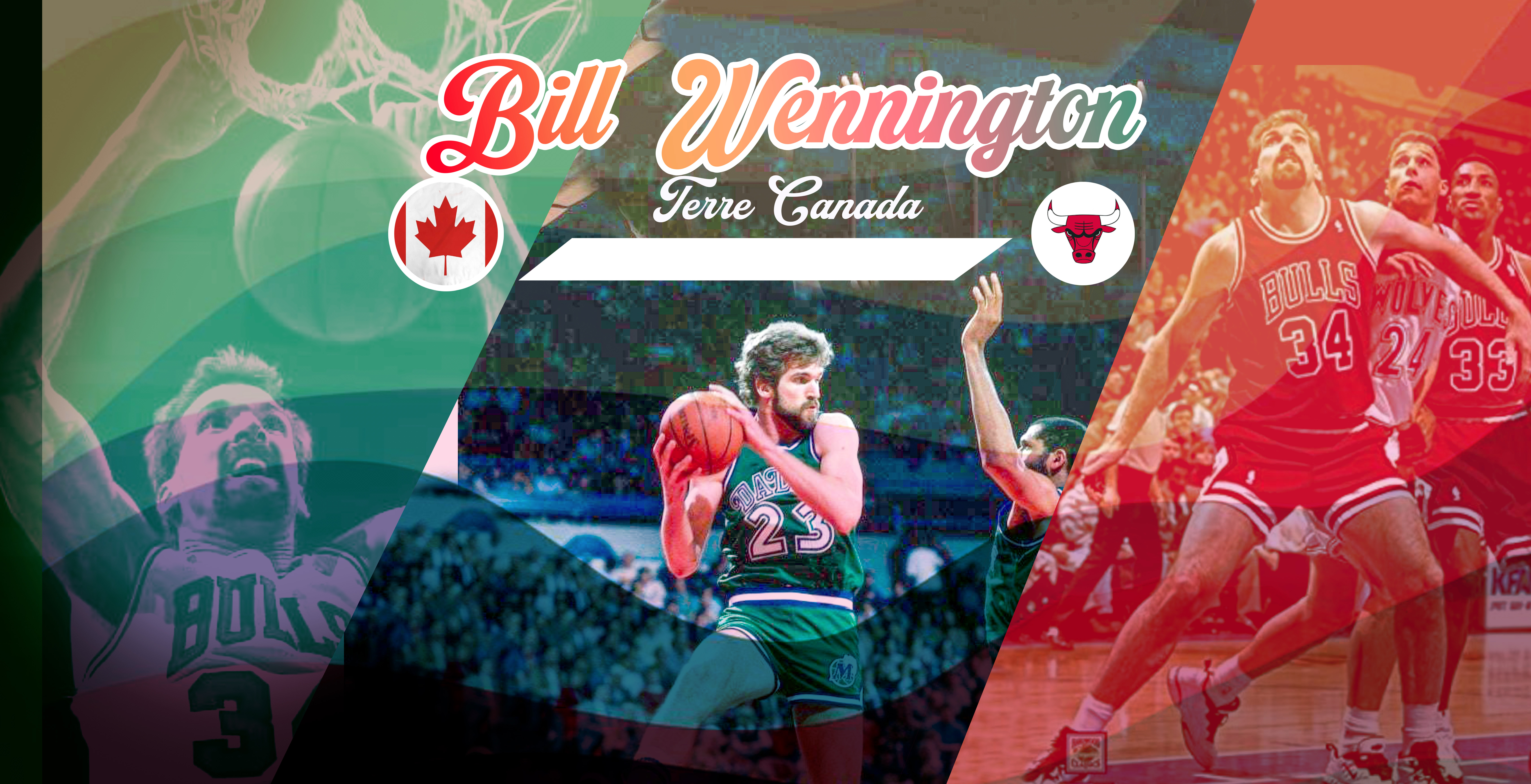
From Team Canada to Italy to the Bulls, the unlikely path of a Canadian big man who found his role on a dynasty
Born in 1963 in Montreal, William “Bill” Wennington was raised on hockey and lacrosse. Until age twelve, he never touches a basketball, instead playing defense in what was, even more than today, Canada’s number one sport in the 1970s. At the time, basketball was only the fourth most popular sport, behind hockey of course, but also baseball and soccer. But pushing six foot three at just twelve years old, Bill is encouraged to pick up a basketball, and it clicks almost immediately with that kind of size advantage over his peers.

A familiar tune heard again and again whenever basketball comes up, especially with big men: he was small, then he grew, they put him in basketball, and he dominated everyone. Basketball is, by nature, a sport shaped by physical advantages, where genetics often tilt the balance.
In 1979, at sixteen (6-10), his parents divorce, and Bill follows his mother nine hours south to New York and Long Island. Basketball becomes his priority, quickly turning into a passion.While he idolizes Julius Erving, he models his own game after Kareem Abdul-Jabbar (who, as a side note, will be his very first matchup in his first NBA game in 1985, tossed into the fire for one minute by the madman Dick Motta, just long enough to give up a bucket to the Big Fella and head back to the bench)
This unusual path, a Quebec native moving to Long Island and then making an NBA career, Wennington was not the first to take it. It is worth noting that in the 1940s, another player followed the exact same path: born in Montreal, moved to Long Island, then spent six years in the NBA with the New York Knicks, from 1949 to 1956.
That player was Ernie Vandeweghe, the father of two-time All-Star Kiki Vandeweghe, a prominent NBA forward of the 1980s. Ernie lived an extraordinary life: NBA player, then Air Force physicist, married to a Miss America, with all four of his children becoming high-level athletes. You can read more about his remarkable journey here.
1981–1985: St. John’s, and a Trip to the Olympics with Canada
Bill becomes increasingly dominant in high school at Lutheran High School, and two years later joins St. John’s University in 1981, the same year as future Hall of Famer Chris Mullin, whom he had already faced on the high school circuit. The two share a room and quickly become friends. They spend four full years there, reaching the NCAA Tournament every time, with the high point being a Final Four appearance (eliminated in the semifinal by Patrick Ewing’s Georgetown in the “sweater game”).
Two years younger, Wennington also plays with All-Star point guard Mark Jackson. With future Spur Walter Berry as well (who will spend most of his pro career in Europe), St. John’s is one of the top college teams in the country.

During that first year at St. John’s, he is selected alongside Mullin to represent the East at the McDonald’s All-American Game, which they win. A chance for Bill to play for the first time with a future teammate in Chicago, thirteen years later: Michael Jordan.
It is also during his college years that he wears the Canadian national team jersey for the first time, at just 19, as early as 1982 at the World Championship, finishing a respectable sixth (3 wins, 5 losses), but most notably in 1983 at the Summer Universiade, winning gold against Dražen Petrović’s Yugoslavia, with the Americans taking bronze despite rosters featuring Karl Malone, Charles Barkley, and Kevin Willis.
Also on that Canadian roster: Gordon Herbert, former Bayern Munich and Germany’s head coach, and Jay Triano, former Raptors and Suns head coach.

With that same generation, they head to the Los Angeles Games the following year, this time overmatched in the semifinal against the Americans, future gold medalists (Mullin, Ewing, Steve Alford, Jeff Turner, Jordan, Sam Perkins), then narrowly missing out on bronze against Yugoslavia.
With St. John’s games on ESPN, Wennington is the only recognizable player on the team, which surprises him when strangers stop him in the Olympic Village in California.
The 1984 roster mirrors the 1983 Universiade team, led by Jay Triano, Gerald Kazanowski, Greg Wiltjer, Tony Simms, Eli Pasquale, and Karl Tilleman. Several players from that Canadian group will be drafted into the NBA without ever appearing in a game, most continuing their careers in Europe or moving on after college.

In his senior year, Bill Wennington establishes himself as one of the best centers in the Big East, a conference loaded with interior talent (Ewing at Georgetown, Rony Seikaly at Syracuse, Ed Pinckney at Villanova, Otis Thorpe at Providence, Charles Smith at Pittsburgh): 12.5 points, 6.4 rebounds, and 1.5 blocks in 31 minutes, on 60% shooting from the field and 82% at the line.
If Chris Mullin is clearly the team’s best player, scouts are keeping a close eye on the Canadian center. His draft profile is well defined: a skilled big man out of a highly competitive conference, reliable from midrange and the free throw line, capable of sliding to power forward, with a strong mindset. But one major flaw, which will follow him throughout his career, keeps him out of the top 10: his lack of impact on the glass. For a seven-footer (his final height is 7-foot), the production falls short of expectations.
1985 to 1991: A mixed start in the NBA
At the 1985 draft, a loaded class featuring Karl Malone, Chris Mullin, Patrick Ewing, Joe Dumars, Terry Porter, Detlef Schrempf, Charles Oakley, Xavier McDaniel, Michael Adams, and A.C. Green, all future All-Stars, including four Hall of Famers, Wennington knows that after his strong senior season at St. John’s, he is likely to be taken late in the first round. Three teams are looking at him to bolster their frontcourt: Dallas, Denver, and Utah.
The Jazz ultimately go with Karl Malone at pick thirteen, then the Nuggets select Blair Rasmussen at fifteen, leaving Dallas to take the Canadian center at sixteen. Those same Mavericks use pick nineteen to draft another center, Uwe Blab, the German out of Indiana, the second German in the class after Detlef Schrempf, also drafted by Dallas at eight.

In Dallas, he joins a strong dark horse team in a franchise still in its early years (just five seasons in existence), coached by the eccentric Dick Motta, with a serious roster: Derek Harper, Rolando Blackman, Mark Aguirre, Sam Perkins, Brad Davis, and Jay Vincent, all in their prime. The weak spot is at center: James Donaldson, the starter, signed in late November from the Clippers after the season had already begun, starts to deal with recurring physical issues, and his backup Wallace Bryant had not convinced the previous year. It is a real opportunity for Wennington, the youngest player on the roster, though he is competing with another rookie for the backup center spot, Uwe Blab.
But like his five years in Dallas overall, this rookie season is uneven: second or even third in the center rotation, on a very good team (highlighted by the 1988 Conference Finals, lost in seven games to the Los Angeles Lakers, the eventual champions), solid enough in his minutes to stay in the league, but not enough to claim a larger role. Across 288 games in Dallas (including playoffs), he starts fourteen times, averaging around a dozen minutes per game.

In the summer of 1990, Dallas moves on from the Canadian center after five full years, sending him to Sacramento in exchange for forward Rodney McCray. For the Mavs, the 1990s will be a decade of shameless tanking, with zero playoff appearances, but Wennington lands in a franchise that is hardly more inspiring.
With the Kings, he reunites with Dick Motta and a roster of lesser caliber than his former teammates in Texas: here, the leaders are Antoine Carr, Wayman Tisdale, and Lionel Simmons. The good news for Bill is that he is going to play. Collectively, the season is rough, with only 25 wins.
Financially, Wennington nearly triples his salary, going from about $20,000 a month in Dallas to $58,000 in California. Statistically, it is still one of his better seasons, even starting 23 games. Still, he considers the 1990–91 season the worst of his professional career.

1991 to 1993: The Italian Escape
The need for a change takes him to Europe, and more specifically to Italy, where he joins Virtus Bologna, a powerhouse coached by the legendary Ettore Messina. Bill takes time to adjust.
He slowly finds his footing again. He grows close to center Augusto Binelli, who, though Italian, spent two years in New York at the same high school as Wennington before going on to spend 17 years in Bologna.
For the first time, Wennington is not used as the lone big in the paint, with Messina opting to go big and slide the Canadian to power forward. In the 1991–92 season, Bologna lets the title slip away to Toni Kukoč and Vinny Del Negro’s Treviso, losing in the semifinal to Pesaro.

But the following season is dominant: first in the league with only six losses, followed by an unbeaten playoff run, sweeping Treviso 3–0 in the Finals and winning by an average of 20 points per game. A frustrating season for Treviso, with 1993 also marking their EuroLeague Finals loss to CSP Limoges.
On Bologna’s side, no European regrets, with a clear quarterfinal exit against Real Madrid, falling at the same stage as the previous year. Wennington is the undisputed starter and logs some of the heaviest minutes across those two seasons, while raising his level in the playoffs.
Winning the scudetto as a key piece of Messina’s team proves to be a turning point for what comes next in his career.
1993 to 1999: The Chicago Bulls Years
At the end of his contract in Italy, the NBA comes calling again, and Wennington is invited to several summer camps in the 1993 offseason. After a first tryout that leads nowhere in Portland, which ultimately signs Chris Dudley, a profile that could easily deserve an article of its own, Bill gets a second look, this time in Chicago, and this one sticks. A one-month contract is signed, and if he does not make the team, the story is over by late November.

Benefiting from Scott Williams’ injury, Wennington shows grit and efficiency early on, earning a standard contract. A very modest salary, even for the time (around $12,000 a month in his first year), but Bill is back in the NBA, and with the best team of the decade. The Bulls are, however, now without Michael Jordan, recently retired after a brilliant three-peat.
At center, the frontcourt appears well stocked at the start of the season: with Bill Cartwright, Scott Williams, Stacey King, and Will Perdue, the Canadian is expected to be at the end of the bench. But injuries and inconsistent play from the four centers already in place lead the Bulls to sign Australian center Luc Longley in February, in exchange for King, and it is Wennington who ends up finishing the season as the second option.
A smart player, he quickly picks up the triangle offense run by Phil Jackson and Tex Winter, who also encourage him not to hesitate when open, which the Canadian does: this first year in Chicago marks his highest shot volume (six attempts in 18 minutes per game on average). Without a high-usage scorer like Jordan, everyone has to be more assertive offensively, including Toni Kukoč, his former opponent in Italy, now his teammate in the 1993–94 season.
Longley and Wennington: a mobile pairing
If he is not a force on offense, Bill has a few moves he controls quite well: a clean midrange jumper, rare at the time for a seven-footer, and a soft right-handed hook. His post game, on the other hand, is less fluid, but where Luc Longley is comfortable operating closer to the rim, in the middle of the lane, Bill can stretch the floor and shoot from 15 to 18 feet, often along the baseline.
Two big men (Longley stands at 7-foot-2), different but complementary in their alternating minutes. A quiet balance that holds for four more years.

After a seven-game Conference Semifinals loss to the New York Knicks, Chicago keeps full confidence in its center rotation, Longley, Perdue, Wennington, but for the 1994–95 season, it is Perdue who starts, in his final year with the club. The major event of that season is, of course, Michael Jordan’s return in March 1995, and Wennington is even on the floor for His Majesty’s first game at Madison Square Garden, a few days after his comeback, the double-nickel game, in which Jordan pours in 55 points without mercy, finishing with an assist with four seconds left for a two-handed dunk by Wennington, sealing the win on his only basket of the night.
The rest of that 1994–95 season plays out in the playoffs. We know the story: a semifinal loss to the Orlando Magic, Jordan wearing No. 45, the summer of Space Jam, and everything that followed.

The Bulls’ 1995–96 season is one of the most famous in NBA history, and for good reason: the best regular-season record at the time, paired with near-perfect playoffs (15 wins, 3 losses). On that team, Wennington returns to his defined role as backup center, with Luc Longley back as the starter after Will Perdue leaves for San Antonio. Injured in the shoulder for a third of the regular season, after a surfing incident, the Australian gives up the starting spot to Wennington for around twenty games.
In 1996–97, Bill plays 61 games, 19 as a starter, again due to Longley’s physical issues, but he himself is injured a few weeks before the playoffs and cannot take part in the second title run against the Utah Jazz. He gets his redemption the following season, the second three-peat and The Last Dance year, appearing in 16 of the Bulls’ 21 playoff games in 1998 and winning a third NBA title at age 35.

After Michael Jordan’s second retirement, the departure of Phil Jackson and his staff, of Scottie Pippen, Dennis Rodman, Luc Longley, Steve Kerr and others, Wennington is one of the few players from the second three-peat still wearing a Bulls jersey in the lockout-shortened 1999 season. In year zero of the rebuild, he drifts alongside Toni Kukoč, Ron Harper and Randy Brown on a team that manages just 13 wins in 50 games.
In September 1999, Bill signs with the Kings for a brief return to California: seven games played alongside Jason Williams, Vlade Divac, Peja Stojaković and Chris Webber before his body finally gives out, and he officially retires on November 1, just a few weeks after signing.
The end of a career that spans thirteen NBA seasons, plus two in Italy. Wennington remains in basketball afterward, becoming a radio commentator for the Bulls.
Three-time NBA champion, Italian champion, Summer Universiade gold medalist with Canada, an appearance at the Los Angeles Olympic Games, and a member of the St. John’s Hall of Fame, Bill Wennington’s résumé is enough to make many professional players pale by comparison.
If he was a leader for Team Canada and a key piece of Ettore Messina’s Virtus Bologna, he was above all a reliable backup center on one of the greatest NBA teams ever assembled, a role player with impeccable professionalism and a team-first mindset recognized by all, someone coaches never hesitated to put on the floor in decisive moments.

Leave a Reply