An elite rebounder, a cult hero in Oakland, and one of the most singular interior players of the 1980s
Larry Smith. Open an American phone book and you will find plenty of them. His nickname, however, is far more distinctive. Mr. Mean. Meant here in the sense of tough, hard-nosed. And information about him is not easy to find.
Smith is a quiet man. His media appearances can be counted on the fingers of one hand, missing a few fingers. A soft voice, hesitant phrasing. More shy than intimidating, he hardly looks mean at all. After retiring as a player, he always remained connected to basketball, notably joining Rudy Tomjanovich’s staff with the Rockets during the 1994–95 back-to-back titles. Still, he rarely speaks publicly about his long career. Larry Smith is not an easy subject for the media.
In a short interview with journalist Tim Roye, we learn unsurprisingly that Smith’s first love was not basketball, but baseball. Growing up in a small town in Mississippi, he played first base throughout his childhood and teenage years. As he grew, basketball became the fallback option, with immediate success. At 19, he joined a small in-state college, Alcorn State. After him, only Lindsey Hunter would go on to have a truly notable NBA career out of that program.
It is already at Alcorn State that Smith earns the nickname Mr. Mean. Gus Howard, the school’s sports information director, notices upon his arrival a closed-off, quiet young man who barely speaks and always seems stern. That is all it takes. One of the league’s most memorable nicknames is born. “Mr. Mean” appears next to Smith’s name in the school’s media guides. A curious detail found in one of those guides. Smith’s favorite player was Bucks legend Marques Johnson, a style worlds apart from Smith’s.
On the court, Smith dominates physically. He is twice named Southwest Conference Player of the Year in 1979 and 1980, in a league that is admittedly not very competitive. In 1979, Alcorn State wins 27 of 28 games, losing in the second round of the NIT to eventual champions Indiana, coached by Bobby Knight. In his senior season, Smith averages 20 points and 15 rebounds in just 33 minutes. Yet as early as 1979, NBA scouts note that Smith cannot shoot and question whether he would ever make it at the pro level.
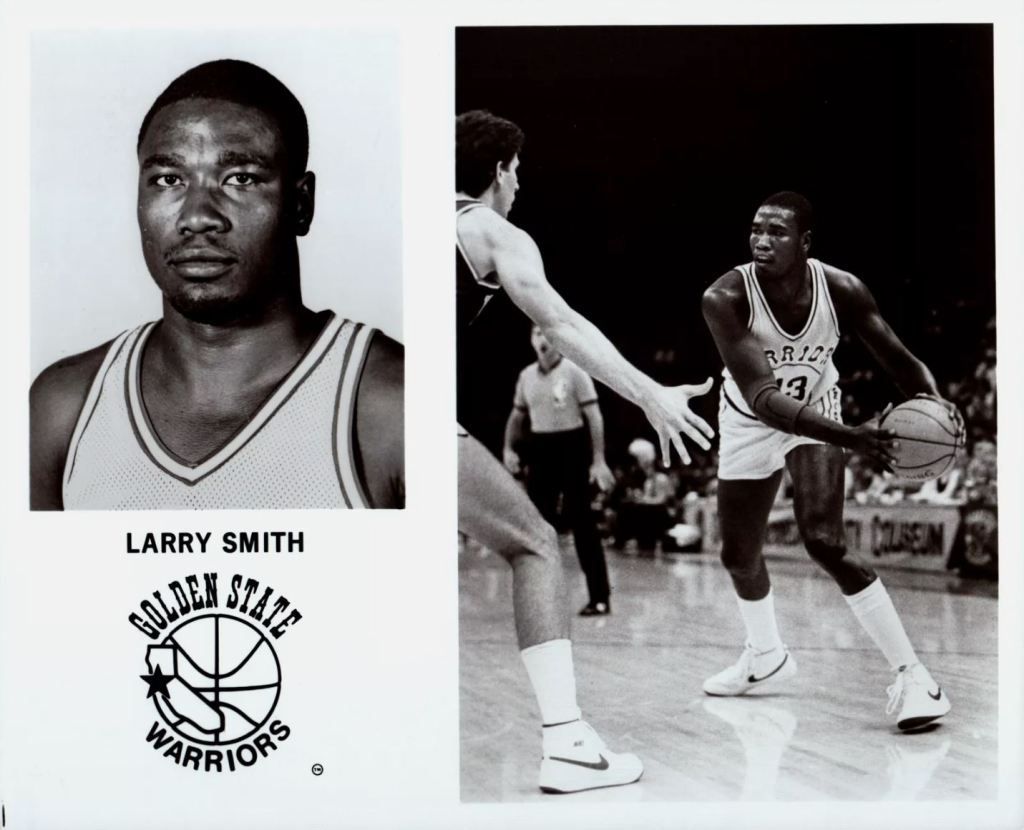
Larry Smith during his rookie season with the Warriors, 1980. Credit: Vintage press photo
1980–1989, the Golden State years
Larry Smith is nonetheless selected by Golden State early in the second round of the 1980 draft, 24th overall. A draft class featuring Kevin McHale, Jeff Ruland, Kiki Vandeweghe, Andrew Toney, and Joe Barry Carroll, the first overall pick and Smith’s future teammate.
Upon arriving in Golden State in the summer of 1980, Smith quickly understands that he will not see much of the ball given how shot-hungry the roster is.
First, Purvis Short. Smith knows him well, having faced him in college when Short played for Jacksonville State. By Smith’s own admission, Short is probably the best Warrior never to be named an All-Star. He would average 28 points per game in 1985 during a bleak tanking season.
Then comes World B. Free. The New Yorker. “One of the most confident guys I ever met.” A polite way of saying one of the league’s biggest egos, paired with a genuine street fighter’s mentality. Fresh off an All-Star season with the San Diego Clippers, averaging over 30 points per game.
A third high-volume scorer completes the picture. Bernard King. Over two seasons with Golden State, he averages more than 22 points, becomes an All-Star in 1982, and later explodes with the Knicks.
Add the first overall pick, Purdue star and seven-footer Joe Barry Carroll at center, and Smith knows exactly what awaits him. The 20 points per game he scored in Mississippi are no longer relevant:
I knew I would have to do what I do best. Rebound and defend. The minutes would come eventually. I know I am not a great player, but there are areas where I am better than a lot of stars.
And it works. Smith nearly averages a double-double as a rookie, 9.6 points and 12 rebounds in 31 minutes. Golden State remains a middling team, reaching the playoffs only twice during the 1980s, but Smith is a consistent starter under every coach. Al Attles, Johnny Bach, George Karl, then Don Nelson.
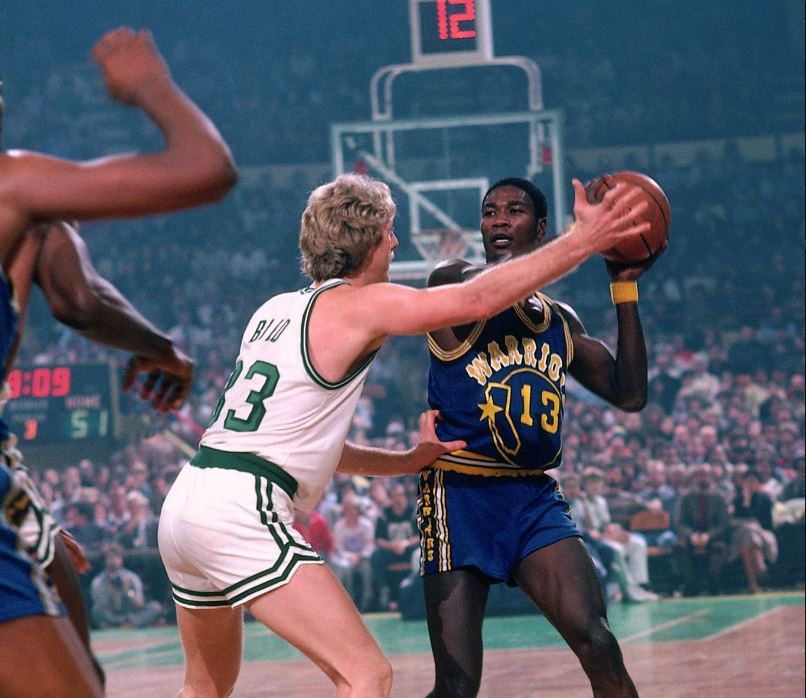
Larry “Mr. Mean” Smith vs Larry “Legend” Bird, sophomore season, 1981. Credit: Dick Raphael
Officially a power forward. More accurately, a full-time paint camper. Tent pitched, stove ready. Smith rarely ventures near the perimeter or the three-point line. But he rebounds. A lot.
He was accepted faster than any rookie I have ever seen. I had never seen veterans sitting on the bench applauding a rookie. They did it for Larry. It took longer for Joe Barry Carroll to earn that respect. Larry had his hands in the dirt.
Al Attles, Warriors head coach, 1969–1983
Smith is even considered a Rookie of the Year candidate in 1981, in a tight race with McHale, Kelvin Ransey, and Darrell Griffith, who ultimately wins the award.
After Smith’s sophomore season, Oakland Tribune journalist Ralph Wiley declares that Smith is a better rebounder than Moses Malone.
Over his career, Smith averages nearly 17 rebounds per 100 possessions, including 7 offensive boards. The same total as Moses, with one major caveat. Smith stands 6 foot 8, while Moses does a few more things on the other end of the floor. Only Dennis Rodman ranks higher, at 21.4 rebounds per 100 possessions.
Let us be clear. With the ball in his hands, Smith is painful to watch. Nothing fluid. Nothing graceful. Beyond 18 inches from the rim, it becomes questionable. Few players have a single-game rebounding record higher than their scoring record. Smith does. 25 points, 31 rebounds. There are many ways to shine.
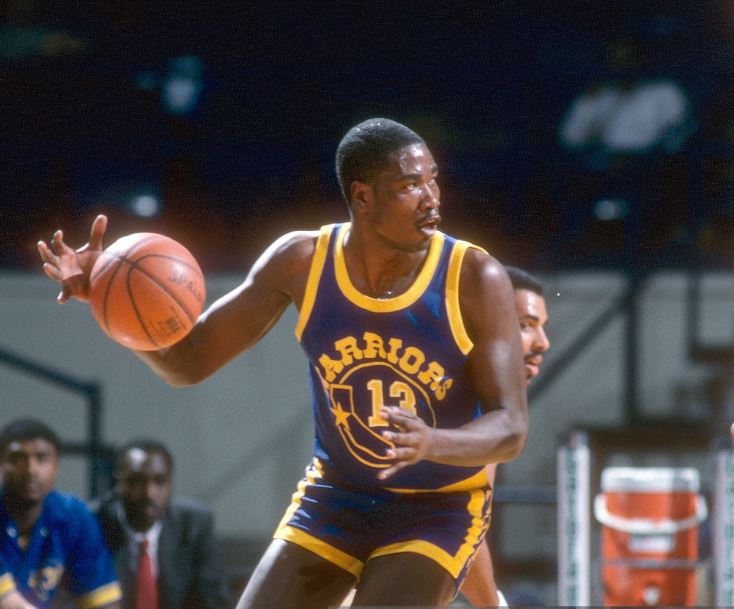
Larry Smith during his sixth NBA season, 1986. Credit: Focus on Sport
The peak of his nine seasons in California is the 1987 playoff run. After a disappointing 42-win regular season, the Warriors, coached by George Karl and led by Sleepy Floyd, Purvis Short, Joe Barry Carroll, Rod Higgins, and a sophomore Chris Mullin, finally win a playoff series by eliminating Utah. Smith spends the series bodying up a young Karl Malone, holding him to 20 points per game on 42 percent shooting, the worst series of Malone’s career. When asked about his toughest defensive assignments, Smith still cites Malone and Buck Williams.
The conference semifinals, a five-game loss to the eventual champion Lakers, remain strong on an individual level. Smith averages 14 points and 16 rebounds, outplaying A.C. Green.
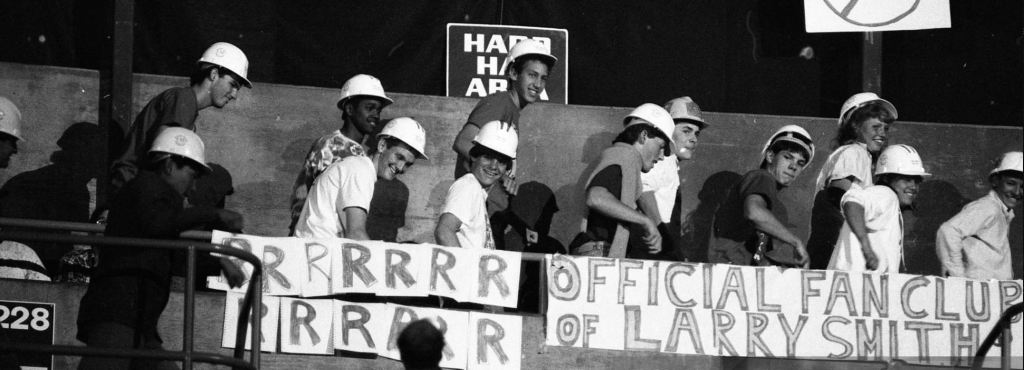
Hard hats required
Smith’s story in Golden State cannot be reduced to defensive metrics or longevity. He is now the eleventh most capped player in franchise history. Fans adore him. For his effort, his energy, the calm demeanor at odds with his nickname, and his complete inability to shoot from more than six inches away.
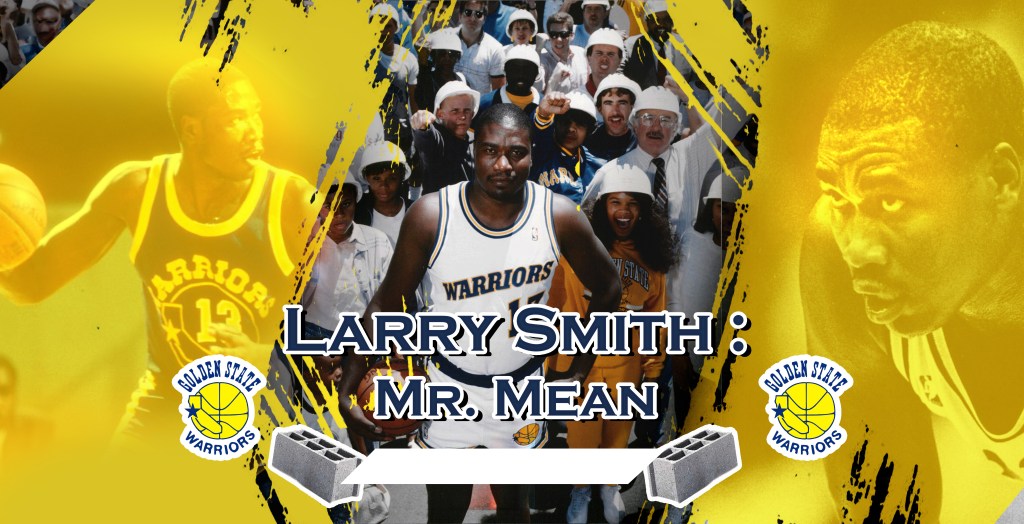
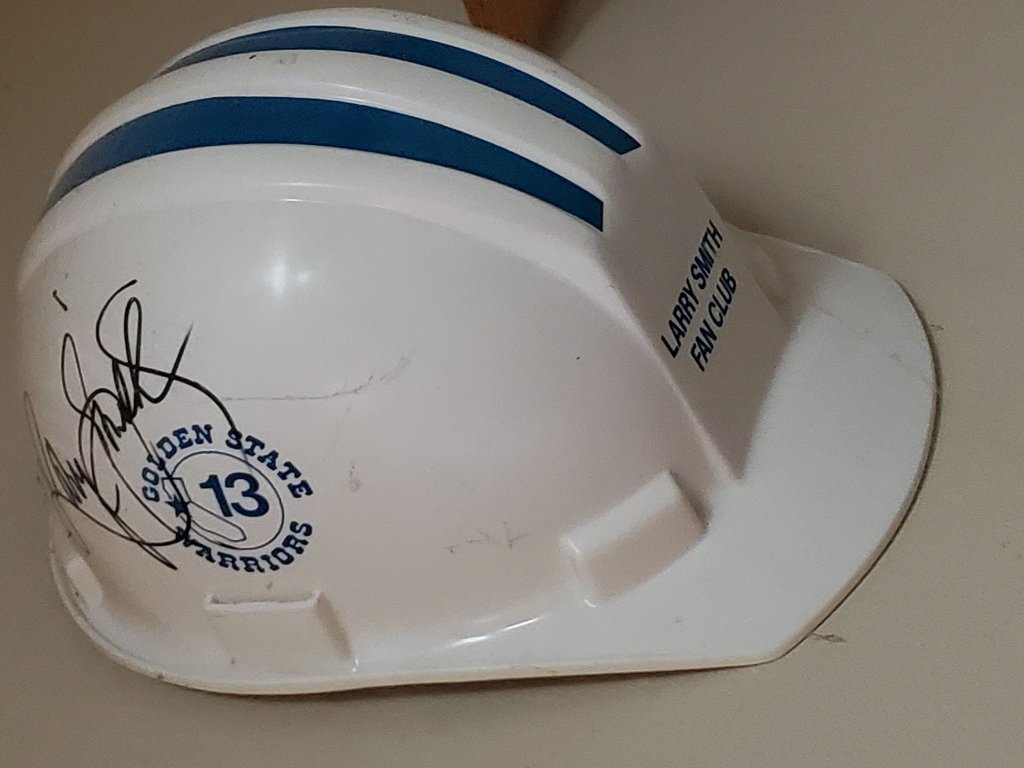
A genuine fan club emerges. Larry’s Local 13. The number 13 being Smith’s jersey number. No membership cards. Just construction hard hats.
Larry Smith’s fan club in action, 1987. Credit: John O’Hara
It starts with two students attending games. One turns to the other and says, “The way Larry shoots, we should be wearing hard hats.”
Former Warriors general manager Bob Myers, a teenager during Smith’s playing days, later admits that Smith was his favorite player. Years later, he would later hope to recapture some of that spirit with Kevon Looney. Without success.
The tone is playful but sincere. The support is real, and Smith is deeply moved by it, even decades later:
They meant so much to me. It was an honor and a privilege to have people come out and share that with me. I loved it. I looked forward to coming to work every day and having that excitement, having those sections cheering for me.
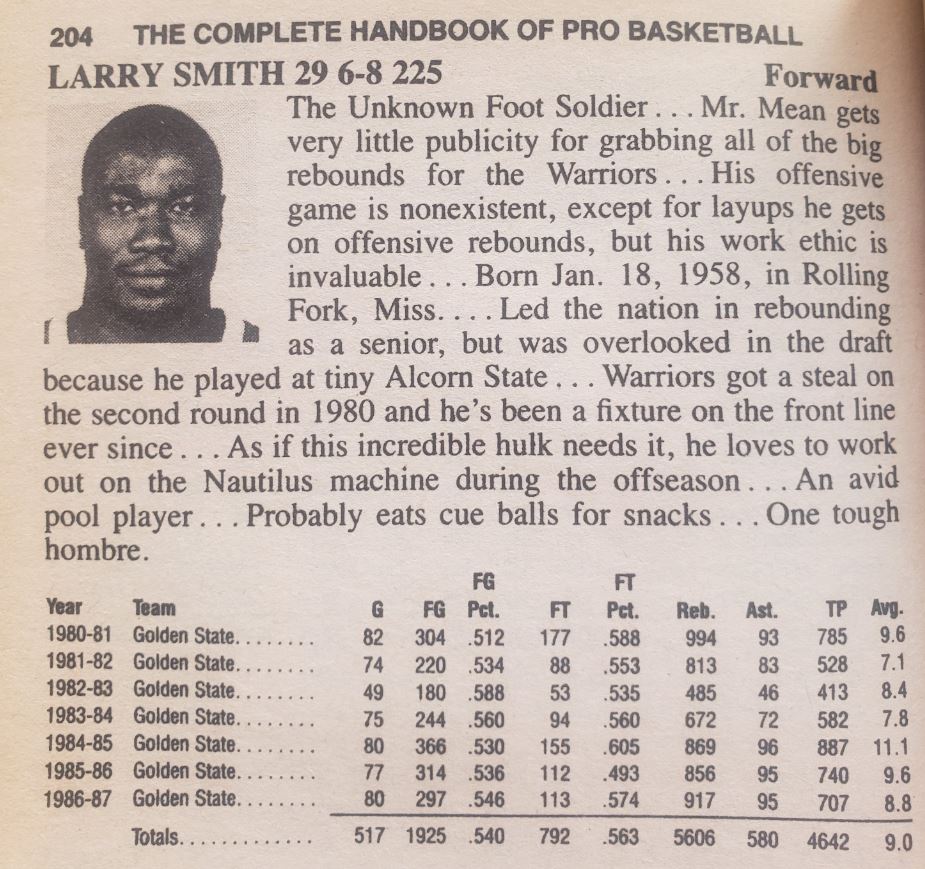
“His offensive game is nonexistent”. Credit: The Complete Handbook of Pro Basketball
1989–1993, veteran years in Texas
A free agent in 1989, Smith signs with Houston, coached by Don Chaney, who needs interior help behind Hakeem Olajuwon and Otis Thorpe. The season is disappointing. Now 32, Smith plays under 20 minutes per game and does not start for the first time in his career.
The only thing mean about Larry Smith is the way he plays. When he does not get 20 rebounds, Larry considers it a bad night.
Don Chaney, Rockets head coach, 1988–1992
In his second season in Houston, Smith benefits from an Olajuwon injury and enters the starting lineup. In 28 starts, he averages over 14 rebounds per game. In February 1991, he records five games with 20 rebounds or more, something not seen since Michael Cage in April 1988.
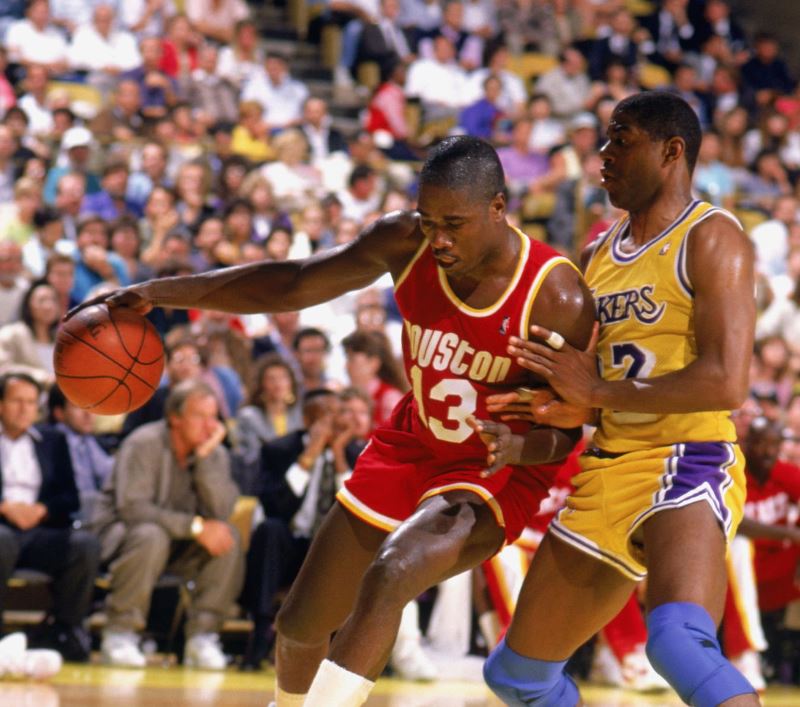
Larry Smith with the Rockets in 1989, still wearing number 13. Credit: Ken Levine
Free throws, however, reach historic lows for him. A career 53 percent shooter, Smith goes 12 for 50 in one stretch. 24 percent.
After a nondescript third season in Houston, Smith remains in Texas, signing with San Antonio for one final NBA season in 1992–93 at age 35. Backing up Antoine Carr, he plays 66 games but sees little action in the playoffs.
Smith retires after 914 NBA games, only 31 in the playoffs.
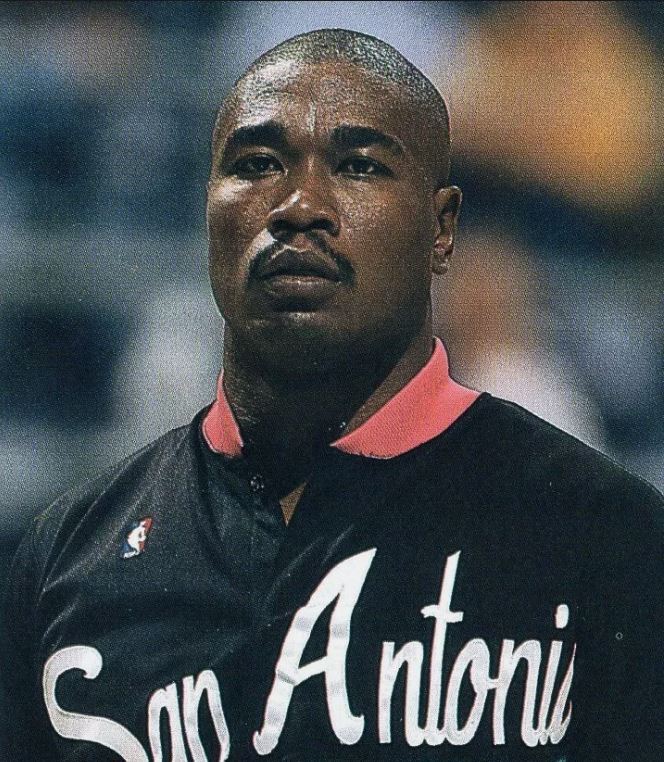
Larry Smith’s final NBA season in San Antonio, 1992. Credit: Topps Stadium
An All-Rookie selection in 1981, he finishes five seasons in the league’s top ten rebounders and leads the NBA in offensive rebounds three times. All this while standing just 6 foot 8. He owns the fourth-best offensive rebounding percentage in NBA history at 15.8 percent, behind Moses Malone, Andre Drummond, and Dennis Rodman.
He never receives the recognition of that trio. But he does own a golden hard hat signed by 25 former teammates and loyal fans:
I look at it every day. Sometimes I get tears in my eyes. Those were some of the best days of my NBA career. My time in Oakland.
A Larry Smith fan club hard hat
Over thirteen NBA seasons, Larry Smith becomes the purest example of a one-sided player in the league. Stone hands on offense. Elite defender and rebounder. A role clearly defined and fully embraced by every coach he played for.
The “poor man’s Dennis Rodman” comparison is not only intuitive. It is fair.
Never an All-Star, Smith remains one of the best rebounders of the 1980s, a Warriors fan favorite from day one, and one of Mississippi’s most iconic basketball figures alongside Bailey Howell.
 Deep Bench Chronicles
Leave a comment