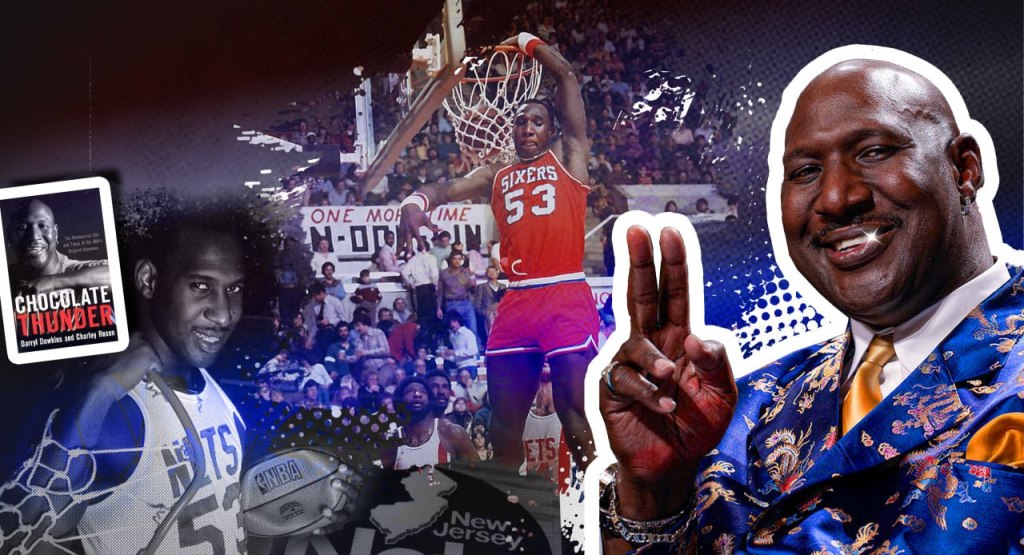
A larger-than-life center, dunk showman, and interplanetary character whose legend went far beyond his résumé
Before getting into the substance, a brief preface about the bird we’re dealing with here.
Darryl Dawkins was, first and foremost, a delirious list of nicknames, enough to fill several volumes of a phone directory:
Chocolate Thunder, The Rim Wrecker, The Go-Rilla, The In-Your-Face Disgrace, Double D, Dawk, Dr. Dunk, Sir Slam, Zandokan the Mad Dunker, Dunk You Very Much, Candy Slam, Sweet D, Big Dawk, Master of Disaster, Squawkin’ Dawkin, Double D Dunk, Sir Dunk, Dunk It, Pure Pleasure, Cool Breeze, Dr. Jam, Demon of Destin, The Spine-Chiller Supreme…

He was also a respectable center, who played in the NBA from 1975 to 1989, with three NBA Finals appearances to his name (all losses).
A talented, strong, big, fast player. The kind who should have broken through and become an unquestioned All-Star. But too unhinged to fully realize himself at the professional level.
Darryl Dawkins did not come from another planet, whatever he claimed, but he had invented one: Lovetron, an imaginary world without gravity, where interplanetary funkmanship was practiced.
That, he said, was where his dunks came from.
A singular character, whom it is difficult not to fall under the spell of.
Portrait and hilarious quotes to follow.
Orlando: the school of hustle
Born in 1957 in Orlando, Dawkins grew up in a modest environment amid full racial segregation (Florida remained under Jim Crow laws until the mid-1960s).
Second in a family of eight children (plus two half-brothers), he was largely raised by his grandmother Amanda Jones, a devout woman and member of the Antioch Primitive Baptist Church, after his father left for New York when he was only seven.
At school, he first stood out for his size (nearly 6-foot-6 before puberty) and for a pronounced taste for mischief. A genuine first-class slacker, an eternal clown.
His grandfather was another source of inspiration… not necessarily in the right way:
“Sure, he knew the Bible back and forth, but he was also devoted to drinking. He was the funniest man I’ve ever met and was also quite a prankster.“
On the dusty courts of Florida, he began basketball, and at Maynard Evans High School he became a local phenomenon and discovered for the first time life without segregation, but also a totally different approach to the game:
“The only things white in Eccelston Elementary School were the chalk and the toilet paper. Black teachers, black principal, black cafeteria workers. […] But at Evans, I had something important figured out. There was a big difference between white and black basketball. White guys made foul shots and passed the hell out of the ball. White guys played team ball. If a guy was hot, he’d get the ball until he cooled off.
The black philosophy was something else. If you’re not scoring points, if your picture isn’t in the newspaper, if you don’t have a trophy, then you ain’t the man you ain’t shit. And if a teammate hit nine shots in a row, the black attitude was: Fuck him, now it’s my turn to get in on.”
The tallest in his school, he who had been mocked and called big dummy, stupid motherfucker, revealed himself on the court. He developed a pronounced taste for comics (Superman, Daredevil, Batman, Spider-Man, Thunderbolt), feeding an already overflowing imagination, and was also discovering the opposite sex. He lost his virginity at 16, with a prostitute. His mother, aware of it, beat him severely, without positive effect:
“It was too late because I’d already developed a hearty appetite for pussy […] If Batman had the Bat Cave, and if Superman came from the planet Krypton why couldn’t I have my own planet? Lovetron!”
He led his team to the state title, dominated the paint, and was recruited by every major university in the country, notably Kansas. But Dawkins was hungry, in the literal sense.
When he saw his grandmother holding two jobs, he quickly understood that college would not pay the bills.
Accustomed to scraping together a few dollars here and there, between odd jobs and petty theft, a window washer by 16, Darryl saw basketball as a legitimate livelihood.
In 1975, he declared for the NBA draft, became the first player selected directly out of high school, and joined Philadelphia with the fifth pick.
A modest class: Alvan Adams, Gus Williams, World B. Free, David Thompson among the most notable (not forgetting Bill Robinzine, whom we will return to later.)
The previous year, Moses Malone had already made the leap from high school, but to the A.B.A. The high school → NBA path therefore remained a first. Three teams wanted him: the Bulls, the Jazz (still in New Orleans), and the Sixers. Agents battled to sign him, offering between $100,000 and $300,000 upfront, the equivalent of nearly two million today.
Philadelphia beginnings: a slacker among the Sixers
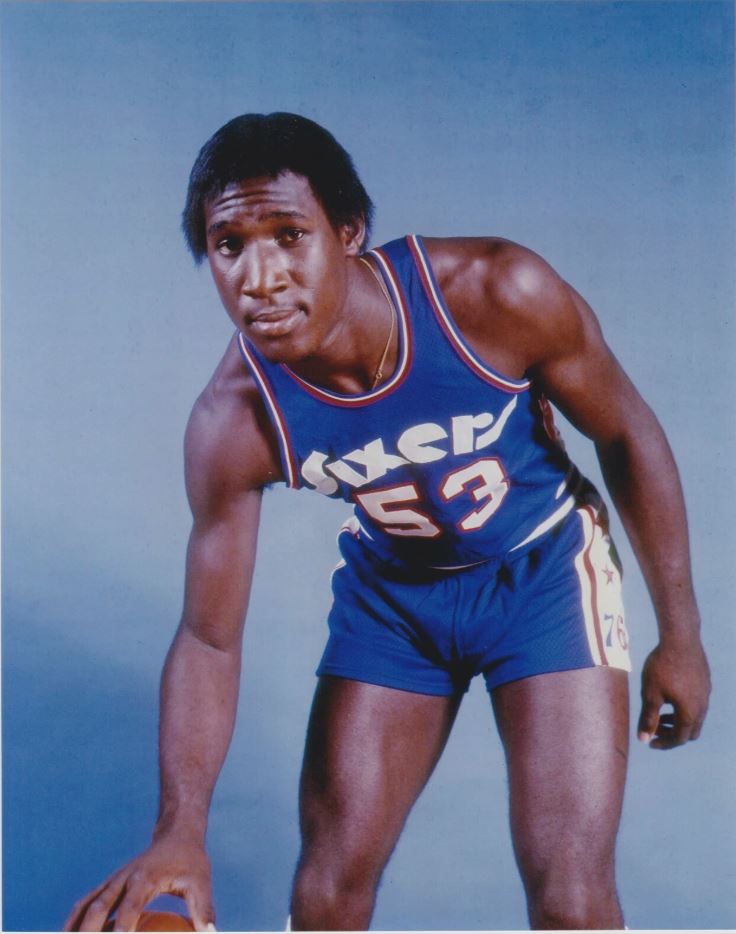
When he arrived in Philadelphia, Darryl was 18, with a kid’s face, an approximate haircut, and a monster’s body: 6-foot-11, 240 pounds, strong as an ox.
Seven years guaranteed on his contract and no thought of putting the money into savings.
Once his family was secure, he spent the rest on clothes about as understated as Bootsy Collins’.
He shared a locker room where cartons of Marlboros did not last the week and mini bottles of cognac did not survive practice:
“Imagine my surprise when I saw Billy Cunningham, Freddie Carter and George McGinnis smoking cigarettes in the locker-room at halftime of a ball game. Damn! These guys smoke in here right in front of the coach? What the hell. If they’re all smoking, then I’m drinking.”
The previous season, Philly had been a bad team (only 34 wins), and two years earlier, nine: the second-worst record in history at that point.
George McGinnis, Doug Collins, World B. Free, Jellybean Bryant (Kobe’s father), Steve Mix, Fred Carter, Harvey Catchings… Talent, yes, but discipline nowhere to be found.
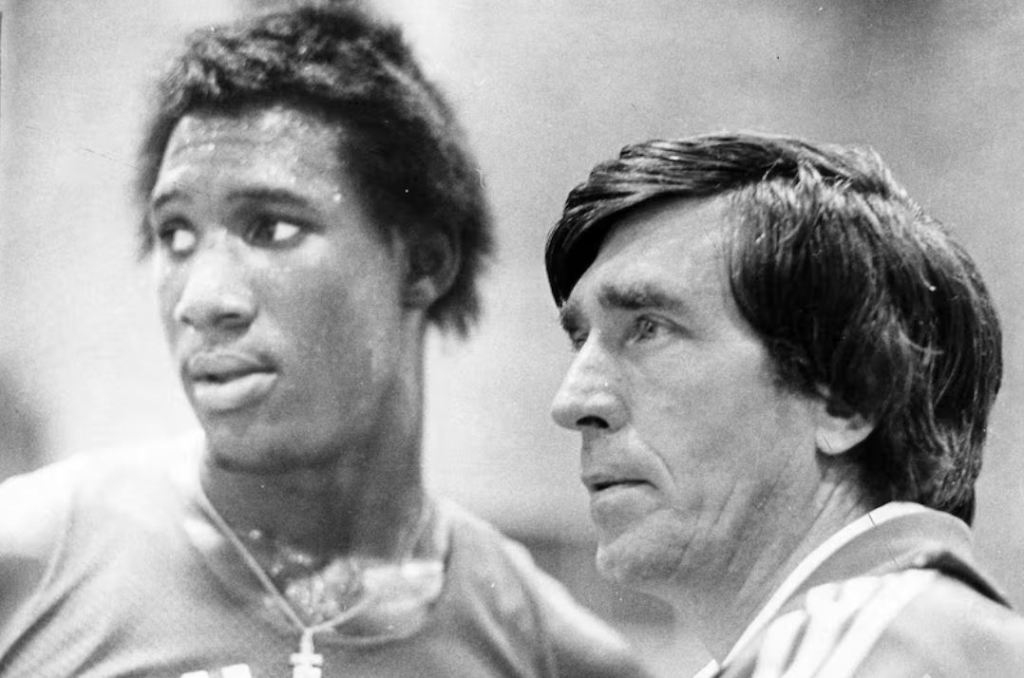
He also discovered that in the pros, friendship had a price. Jealousy over money, women, playing time… Over his career, Darryl would form real bonds with only three players: World B. Free, Earl Cureton, and above all Bobby Jones.
His rookie season mostly unfolded from the bench. Gene Shue, the coach at the time, did not know what to do with this laughing giant who spent more time clowning than learning the system. He eventually forbade him to shoot, simply and outright.
Yet flashes appeared: thunderous dunks, authoritative blocks… but also foolish fouls and plenty of weed smoked, which, let’s be honest, did not help him retain plays.
Sophomore alongside Dr. J: Sex, drugs & NBA Finals
The following year (76–77), Darryl gained playing time but scattered himself heavily in his off-court life, which he readily admits. A girl (well, several) in every port, inseminated ova here and there:
“For pure, lustful sex, the late ’70s to the early ’80s were the best of times. Nobody ever heard of AIDS back then. The worst you could catch was the clap, and the team’s trainer had pills for that. That’s why it was so hard for married guys to be faithful. No matter how pretty or sweet-smelling your wife was, there was always a girl on the road who was prettier, smelled sweeter, had that certain walk that made her ass pop, and knew how to come at you.
Then, now, and forever, the NBA’s pussy haven was Salt Lake City. Ummm-umm. That’s the main reason why black guys want to play for the Jazz. The second-best pussy capital was Atlanta, with New Orleans a close third. By far the worst place to get laid was New York City, only because the girls there couldn’t be trusted.
One of my nicknames was Big Freak because I was always sexually adventurous. Putting whipped cream on a girl’s titties, chocolate syrup on my dick, I did all that stuff. Wilt Chamberlain used to say that he’d had 20,000 women. Maybe I’ve had a 1,000, so I was never more than a button on Wilt’s shirt. But I never did anything to manipulate a woman so that she felt obliged to give me her pussy.”
On the court, Philly strengthened: Henry Bibby (Mike’s father) at point guard, and above all Julius Erving, the superstar of the ABA’s New York Nets.
At only 26, Dr. J already had the knees of a late-career veteran, but he adapted his game, still aerial, and took the Sixers spotlight from George McGinnis, who obviously took it badly.
Tension in the team, as in the league.
Darryl observed that the NBA had nearly 80% Black players but only three Black head coaches. Clear racism in the league in his view, just as many white players did not deserve their place among the pros:
“Black players were mostly on their own. And when we did get together we’d talk about how few white players really deserved to be in the NBA. Among these were Bobby Jones, Gus Gerard, Bill Walton, Dan Issel, Rick Barry, Paul Westphal, maybe Don Buse and Pete Maravich (not that Pistol Pete was such a great player, but he was talented and he did put booties in seats). Most of the other whites in the leagues were there only because of their skin color.”
Racial tension was an acknowledged fact in the league. For Darryl, and, according to him, for most Black players, certain tacit rules did not get debated: never get dunked on by a white player, nor even get trash-talked by one.
Best record in their conference, Philly reached the 1977 NBA Finals against Portland, a synthesis of what he had observed throughout the season:
All the racial undertones seemed to come to a head. It’s not politically correct to make this kind of definition these days, but we played black basketball and Portland played white basketball. The white players at the core of Portland’s success were Dave Twardzik, Bobby Gross, Larry Steele and Bill Walton. The black guys on Portland also played white basketball. Maurice Lucas was a good, strong power forward but it was Lloyd Neal who killed us.
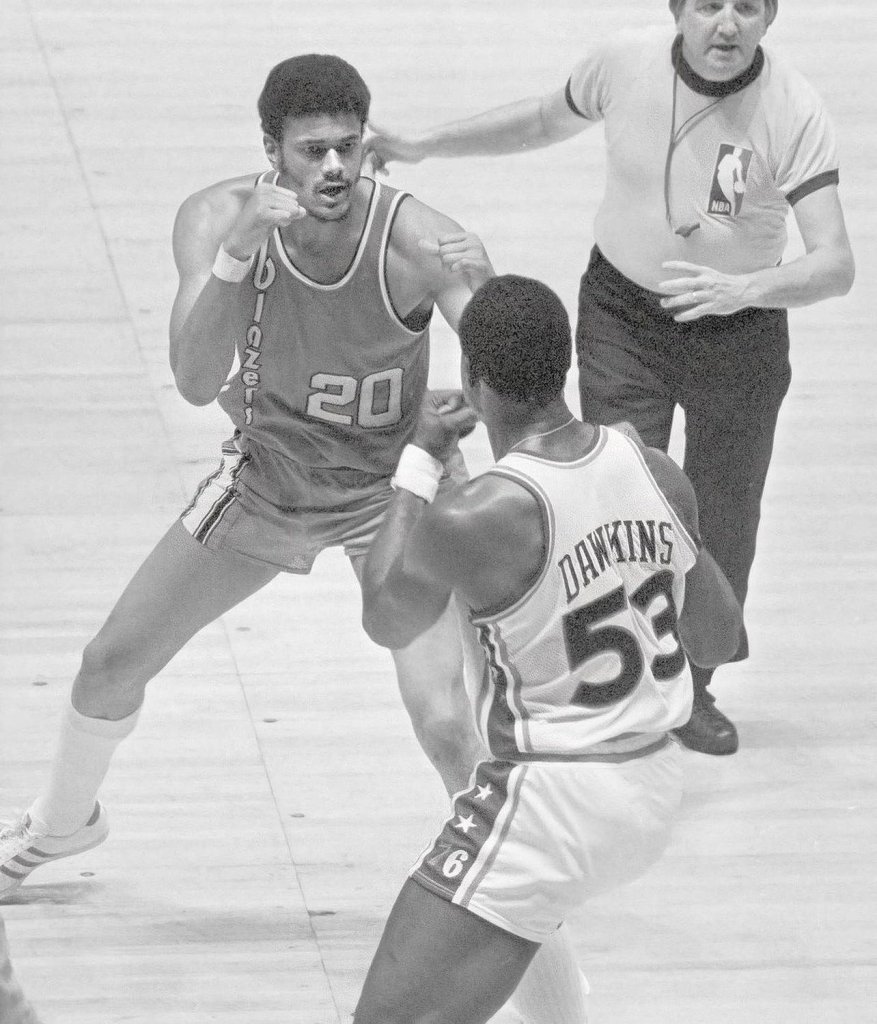
Maurice Lucas, indeed, with whom Darryl starred in a memorable fight in Game 2 and a sink ripped from the locker room wall. Lucas apologized before Game 3 and everything was forgotten. But Portland was better organized and won the series 4–2:
“My honest opinion then and now is that black players are more talented than white players, and we certainly were more talented than Portland. And the rock-bottom reason why the Trail Blazers beat us was because they played white basketball better than we played black basketball.”
Individually, Darryl finally became a true backup center behind Caldwell Jones, with nearly 19 minutes across the six games, a fine step for a 20-year-old sophomore, especially at that time.
But he took no pleasure in playing on an ultra-talented yet disorganized team in constant conflict.
He even admitted sulking at not seeing enough of the ball in the Finals, and not giving full effort on defense or the boards.
Shattered backboards and the birth of a legend
Over the seasons, Darryl finally found his place. Gene Shue was dismissed early in his third year, and under Billy Cunningham (his former teammate turned coach at 34, two years after retirement), he gradually established himself as a starter.
His best season remained 1979–80 (his second NBA Finals run) with about 15 points, 9 rebounds and 2 blocks in 32 minutes (80 games).
In terms of play, he remained inconsistent. The Sixers wanted to make him a future franchise player, but he did not assume the role. Constantly plagued by fouls, rarely fully committed on defense. He drank a lot and used more drugs, mainly cocaine and marijuana. As a showman, however, he was inimitable:
“I really liked the idea of entertaining the fans. Sometimes when I took a charging foul from a guard I’d back up and slide on my ass like I’d been hit by a freight train. Or when I’d make a jump shot, I’d run downcourt with big eyes and a hallelujah smile. Or else when a referee made a bad call against me, I’d storm over to him like I was about to rip his head off, but then I’d smile and bow and tell him that he’d made the right call. I used to listen to George Clinton and Parliament–Funkadelic, so I talked to reporters about my interplanetary funkmanship.”
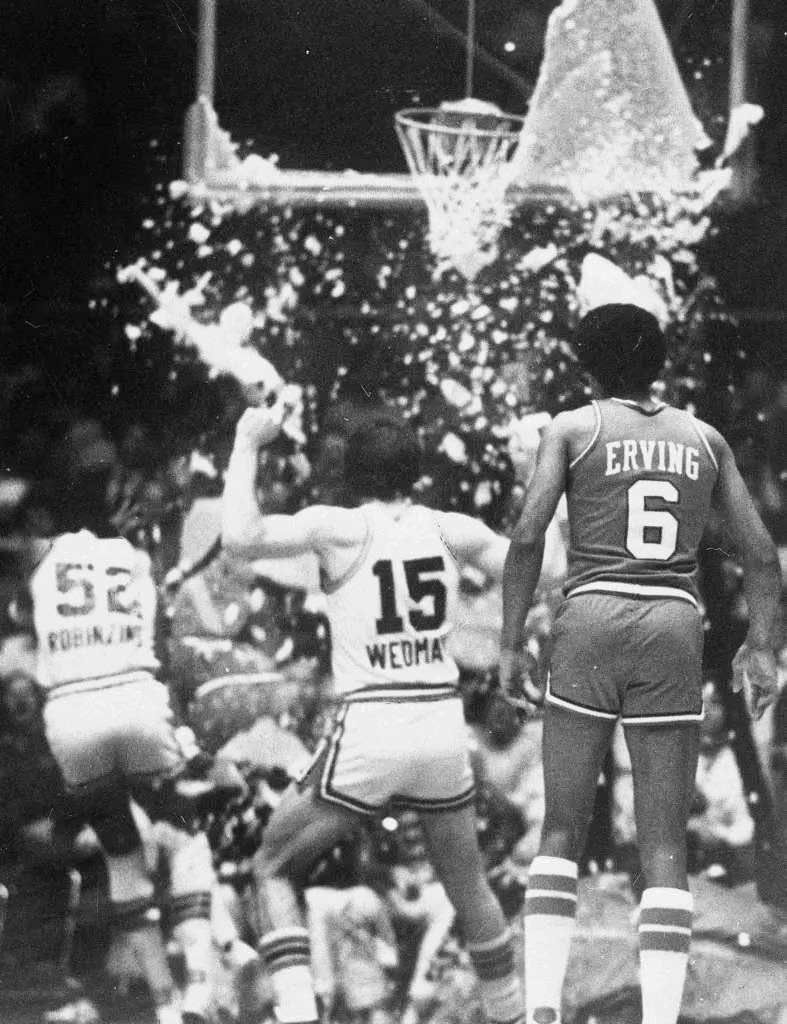
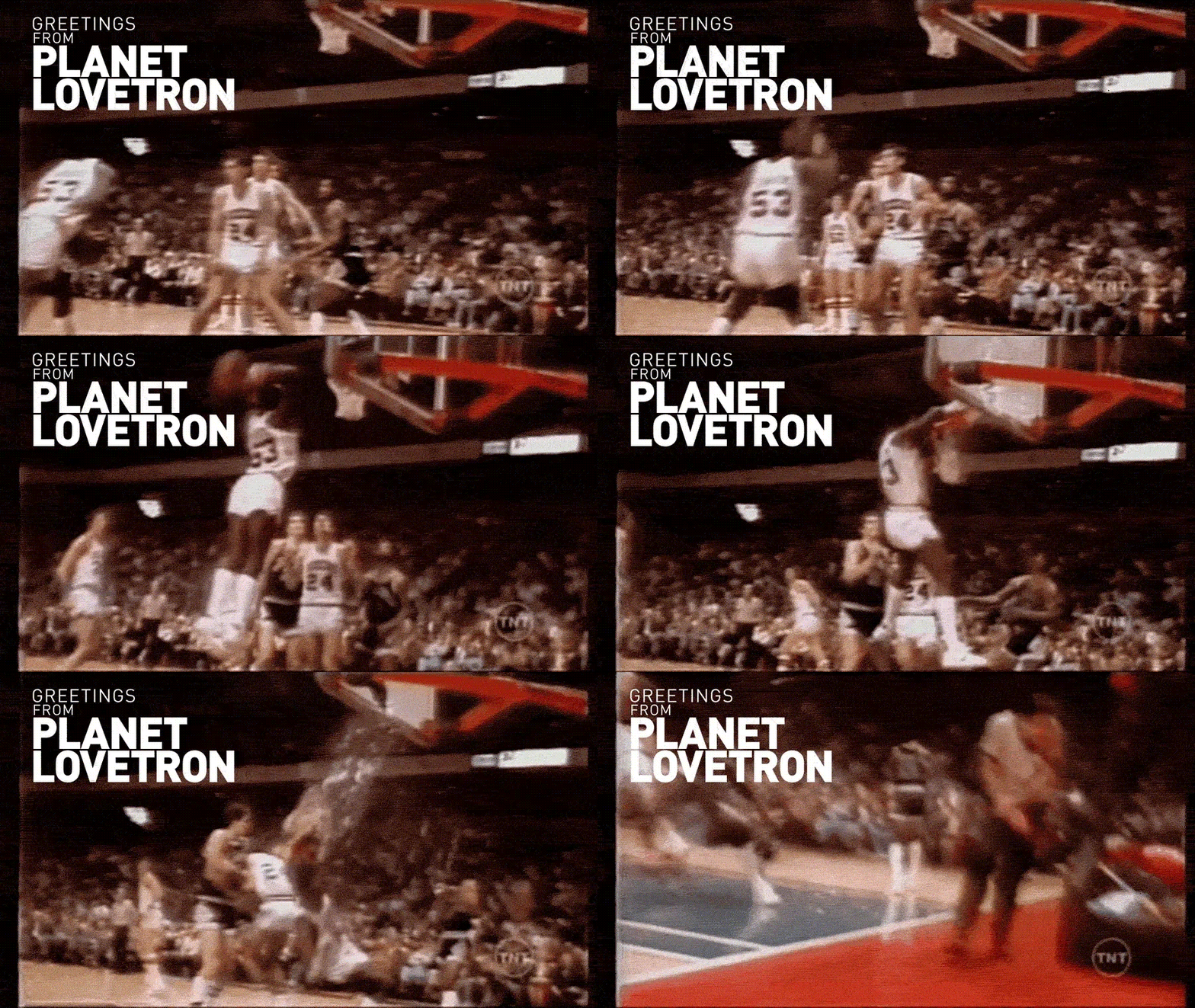
Everything changed on November 13, 1979 in Kansas City. In a game against the Kings, Dawkins rose at the rim, struck the backboard and shattered it. Something he had predicted, amused by an article he had just read recounting that Gus Johnson had managed to break a rim on a dunk in a preseason game during the Baltimore Bullets era. A deafening Dawkins dunk: shards everywhere, a stunned Bill Robinzine underneath. Poor Robinzine, whose portrait I once drew here, a tragic story marked by a devastating mid-career suicide. At the press conference, Darryl bragged:
“I didn’t mean to destroy it. It was the power, the Chocolate Thunder. I could feel it surging through my body, fighting to get out. I had no control.
I called this one the Chocolate Thunder Ain’t Playin’ – Get Out of the Wayin’ – Backboard Swayin’ – Game Delayin’ – Super Spike! And I was also inspired to give myself another nickname, The Master of Disaster.”
Two weeks later, he did it again in Philadelphia against San Antonio. The NBA had enough and promised him a $5,000 fine if he broke a third backboard.
In response, the league invented the breakaway rim, the spring-loaded rim that would become the global standard. Dawkins, meanwhile, became an even bigger media phenomenon.
The frustrated class clown of the Sixers
Behind the show, Dawkins remained an unmanageable player. Too talented to be a role player, not consistent enough to be a star.
The press spoke of “potential” for ten years, a word he eventually came to hate. His constant fouling plagued him, he grew irritated at never receiving the ball from Maurice Cheeks (who, in his view, had eyes only for Dr. J), and relations with Billy Cunningham were tense.
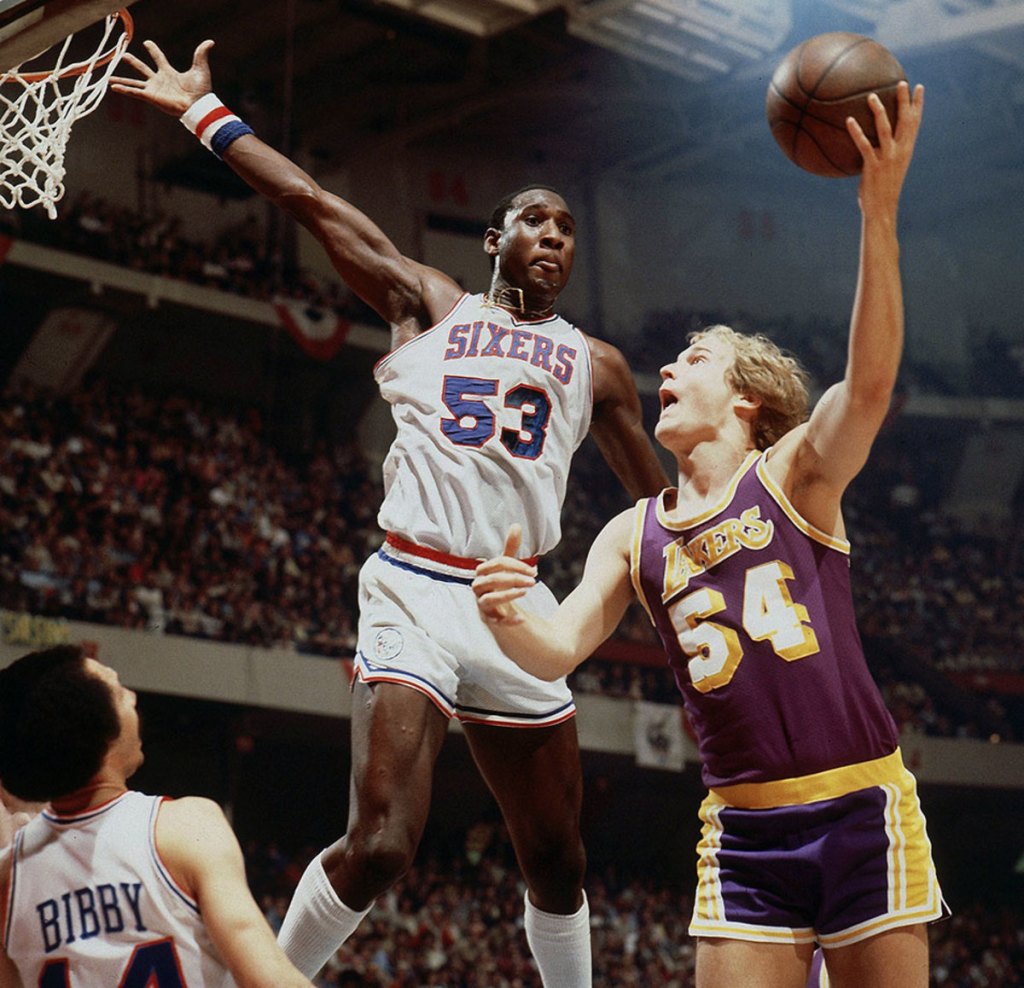
Despite everything, Philly reached three Finals between 1977 and 1982 without ever winning. The trade sending George McGinnis away for Bobby Jones at least marked the beginning of a true friendship for Darryl.
In the summer of 1982, after seven seasons in Philadelphia, he was traded to the New Jersey Nets for a first-round pick, while the Sixers acquired Moses Malone, the center who would deliver them the title the very next season.
Perfect irony.
New Jersey Nets: two strong seasons, then injuries begin
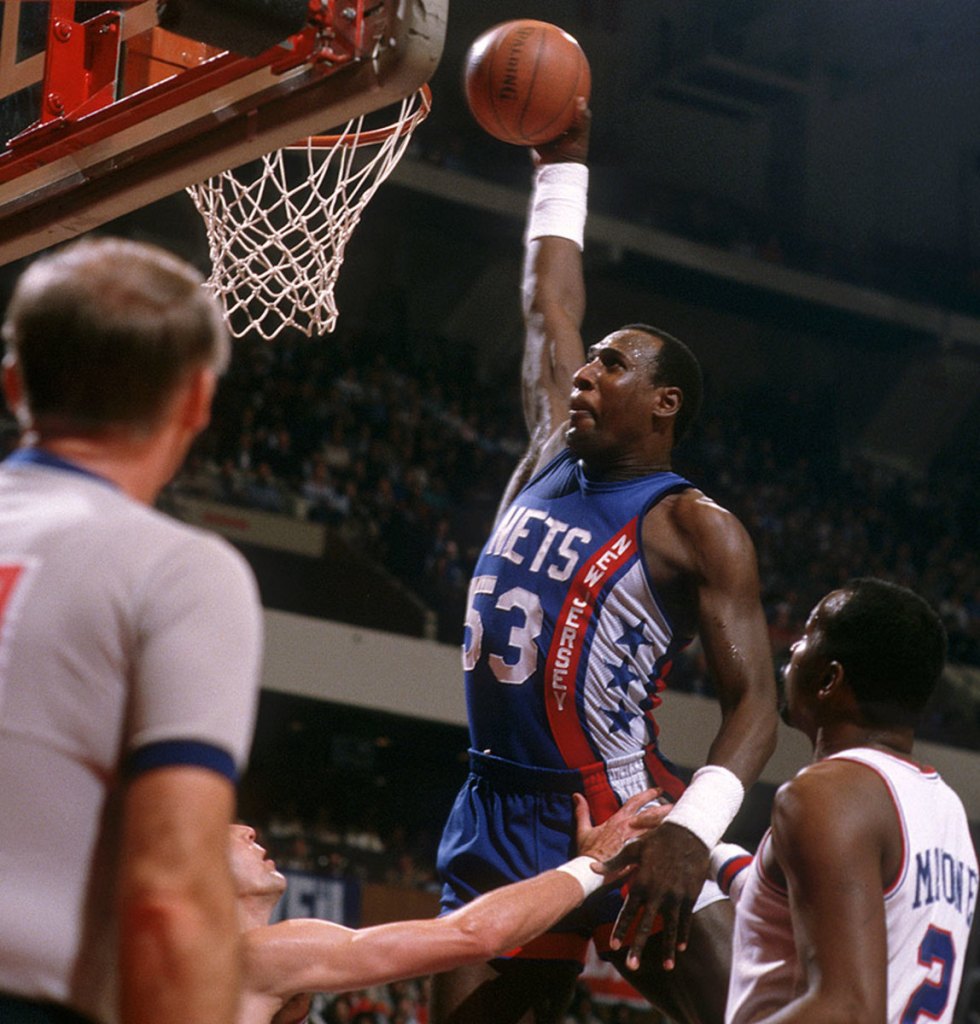
With the Nets, Dawkins enjoyed a strong start. Less pressure, better listened to, he became a true starting center.
The first season remained complicated: he clashed badly with Larry Brown, whom he accused of running the entire offense through All-Star Buck Williams. Despite that, he put together two solid seasons, approached 17 points per game, and led the Nets to their first playoff series win… against his former Sixers.
Stan Albeck replaced Brown as early as 1983–84, and Dawkins finally found good rapport with a coach, he who was extremely difficult whenever the offense did not revolve around him.
But his back gave out. Injuries piled up, as did surgeries. He returned intermittently, tried to adapt, but his body no longer followed. Some tax issues as well, and questionable financial investments… the usual for Dawkins.
After four seasons with the Nets, he was traded early in the 1987–88 campaign, but was no longer capable of holding a real NBA role. He was only 30.
A career winding down
In 1987, he briefly passed through Utah (four games), just long enough to clash with Karl Malone after sleeping with his girlfriend, then Detroit. With the Pistons he played 16 games, during which his first wife committed suicide. Darryl collapsed, ballooned to 300 pounds, and chose to walk away: he retired from NBA courts at 32.
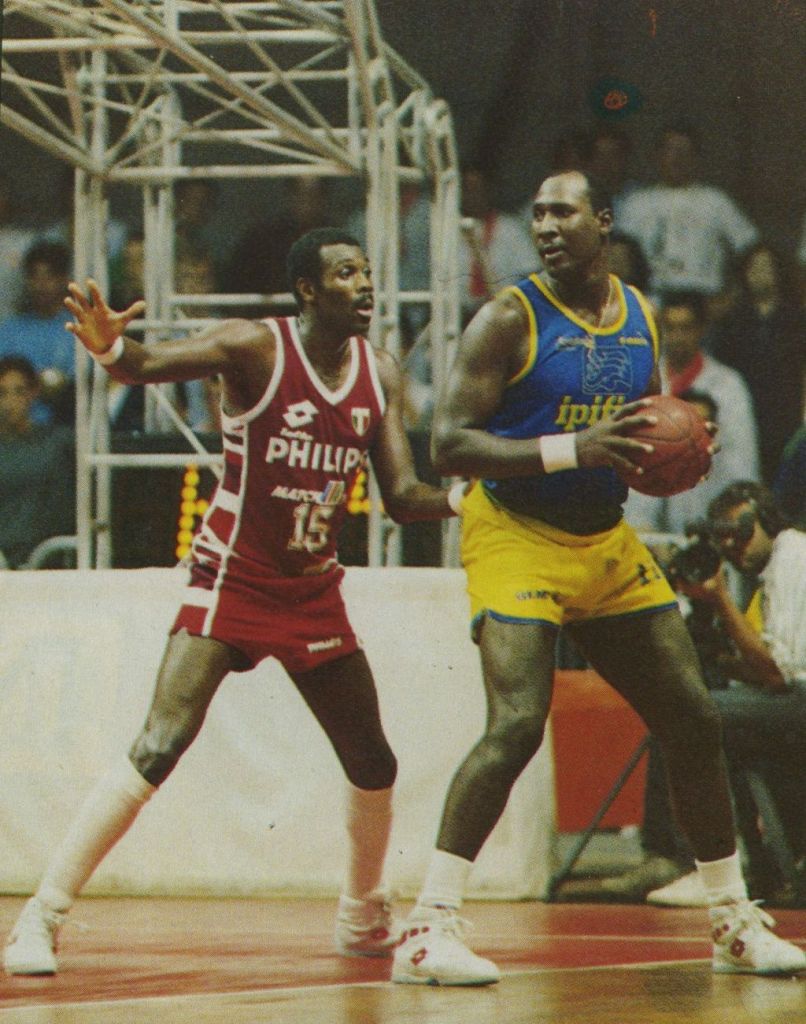
What followed was less glorious: several seasons in Italy (Torino, Milan, Forlì), a stint with the Harlem Globetrotters (he became the first former NBA player to wear their uniform), then the CBA, before becoming a coach in minor leagues.
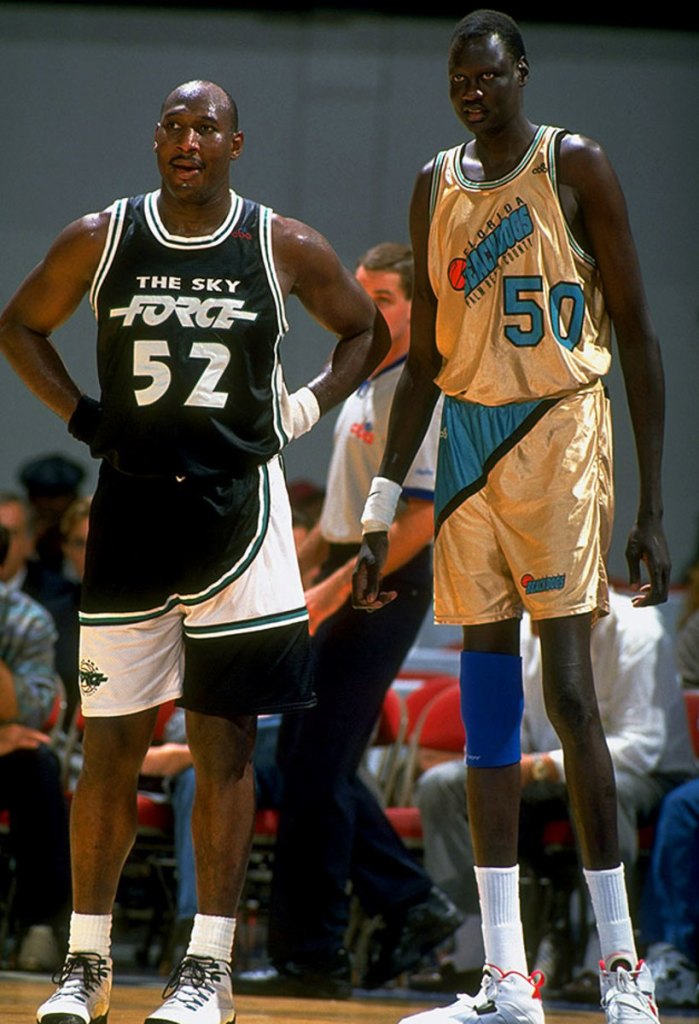
He coached the Pennsylvania ValleyDawgs, then the Lehigh Carbon Community College team, where he tried to teach what he had never learned: discipline.
He remarried. Divorced shortly after. More tax trouble.
A personality greater than his résumé
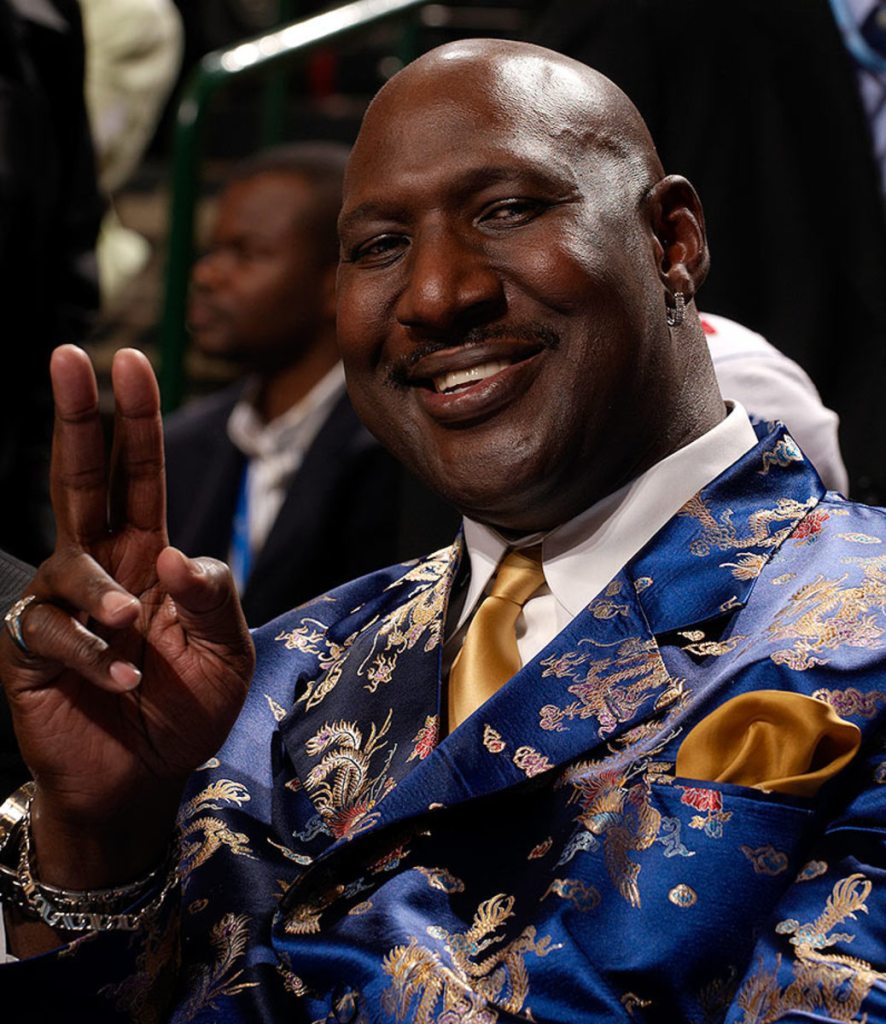
In the 2000s, he became a popular figure, invited onto courts, into video games (NBA Jam), and several documentaries.
The league regularly sent him abroad as an ambassador, notably to China, for events meant to popularize the NBA.
He was of course sought as a judge in dunk contests across the country, and likely ran more youth basketball camps than most players of his generation.
A player without an All-Star selection, but perfect in this ambassador role, as his warmth, wit, and natural charisma were universally appreciated.
The sudden passing
Darryl Dawkins died in August 2015 in Pennsylvania, victim of a heart attack at 58.
He did not change basketball through his résumé, collective or individual (even if he reached three NBA Finals), but he marked the league with his swagger and madness.
A flamboyant player, definitively apart, living in a parallel universe where moderation, taxes, and abstinence did not exist.
The quotations in this article come from the book Chocolate Thunder: The Uncensored Life and Times of Darryl Dawkins, his autobiography co-written with Charley Rosen and published in 2003.
A breath of fresh air, far from sanitized and soporific biographies in the Roland Lazenby mold. Bad faith, hilarious punchlines, a tendency to racialize absolutely everything, Darryl tears into players sometimes gratuitously (Robert Parish, David Thompson, Jason Williams, John Drew…) but we love it once we understand the Dawkins character.
Every other page could earn him criminal charges in 2026, but wherever he is now, I suspect he couldn’t care less.
Rest in peace, Chocolate Thunder.
 Deep Bench Chronicles
Leave a comment